
Ready to get started?
Easily integrate next-generation payments and financial data into any app. Build powerful products your customers love.
SHARE ARTICLE


 Share link copied!
An A2A (account-to-account) payment moves money directly from the payer’s bank account to the payee’s, with no card or card network in between. In the UK, A2A payments run over Faster Payments and the customer approves them in their own Bank app through open banking. With Atoa, Pay by Bank settles in seconds and costs from 0.7% + VAT.
What is an A2A payment?
An account-to-account payment, usually shortened to A2A, is a payment that moves money straight from one bank account to another. There is no card in the middle, so there is no card network taking a scheme fee, no acquirer taking a margin, and no chargeback mechanism sitting behind the transaction for four months. In the UK the modern version runs over the Faster Payments system and is initiated through open banking, which is why you will also see it sold as Pay by Bank, instant bank pay, bank payment or, occasionally, “a to a payments”. Same thing: the customer approves a payment in their own Bank app and the money is in yours in seconds.
Most of what is written about A2A payments is written for payments companies. This page is written for the people who decide how a UK business gets paid: what an A2A payment looks like at the till and on a phone call, what it costs against a card on real volumes, what happens when a customer wants money back, and where the limits are.
How Does A2A Payment Processing Work?
Whether the customer is at a counter, on a phone call or at an online checkout, an A2A payment follows the same four steps.
- The customer chooses to pay by bank. They scan a QR code on the terminal, open a payment link sent by text or email, or choose Pay by Bank at checkout.
- The provider sends a payment request. The business’s payment provider, acting as a regulated payment initiation service provider, sends the customer’s bank a request with the amount and payee already filled in.
- The customer approves it in their Bank app. They confirm with Face ID, a fingerprint or a passcode, which meets Strong Customer Authentication without a card being involved.
- The money moves over Faster Payments. The provider’s dashboard shows the payment as settled, usually within seconds, and the funds are in the business’s account.
How Much Do A2A Payments Cost Compared with Cards?
A UK card payment carries interchange (capped at 0.2% debit and 0.3% credit for consumer cards), a scheme fee and the acquirer’s margin. It typically lands somewhere between 1.3% and 1.75% in person, and higher online once gateway and fixed fees are added. An A2A payment has none of the first two and a much smaller version of the third. The full head-to-head is in our comparison of open banking against card payments, and the numbers that matter are below:
| £100,000 of monthly takings | Card at 1.5% + 20p (online) on 2,000 payments | Pay by Bank with Atoa, 0.7% + 20p online | Pay by Bank with Atoa, 0.7% in person |
|---|---|---|---|
| Processing fee (ex VAT) | £1,900 | £1,100 | £700 |
| Chargeback exposure | Yes, up to 120 days | None | None |
| Settlement | 1–3 working days | Seconds | Seconds |
| Data you hold | Card details in scope for PCI DSS | None | None |
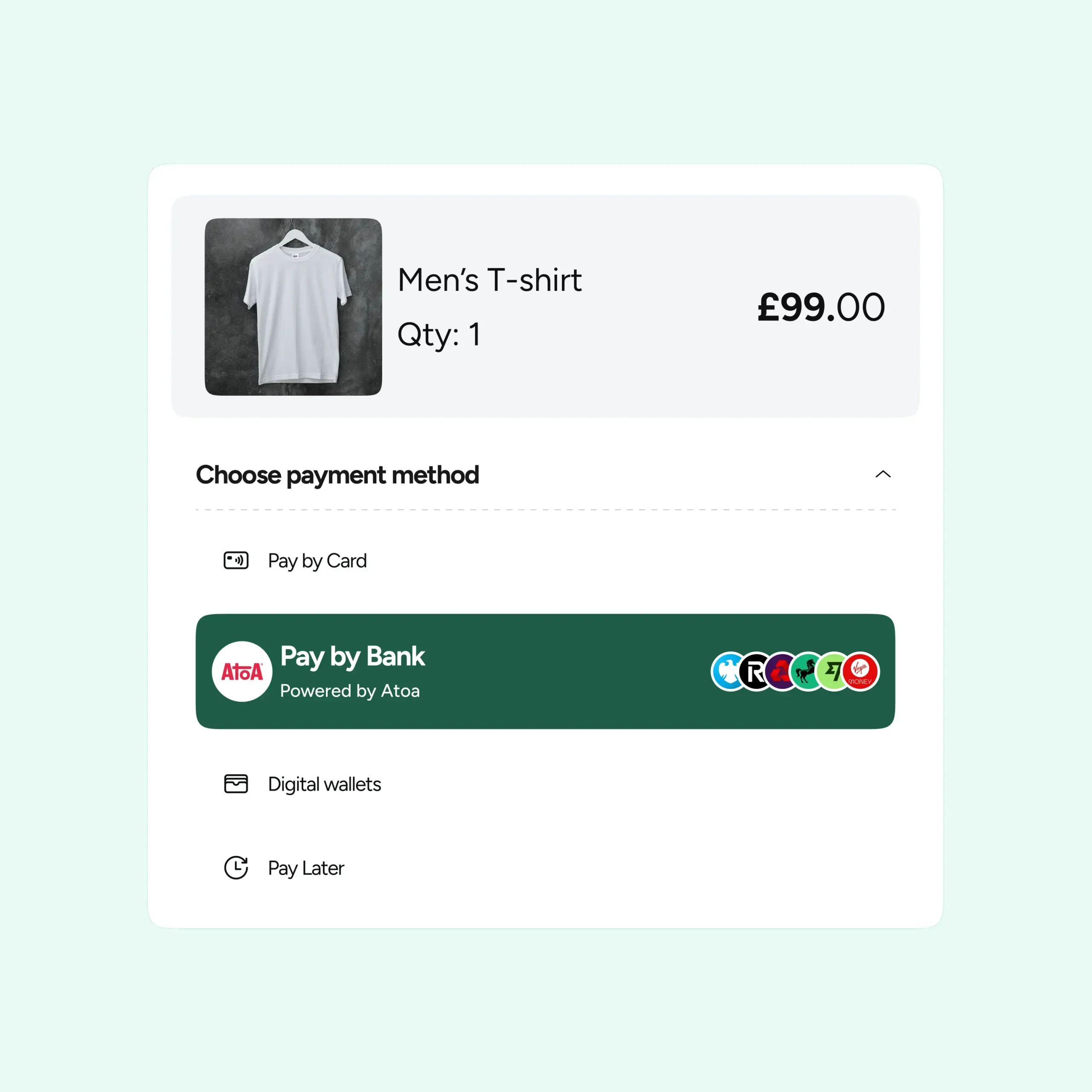
Atoa’s Pay by Bank starts at 0.7% in person and 0.7% + 20p online, ex VAT, and falls as volume rises. UK domestic card payments on the same platform start at 1.3% and 1.3% + 20p (pricing). Both run on the same terminal, link and checkout, with Pay by Bank presented first and card kept as the customer’s choice, which is how most Atoa customers move the bulk of their volume across without offering an incentive. How that rate compares with other providers’ published Pay by Bank prices, including capped and flat monthly plans, is worked through in our comparison of open banking payment providers.
Where UK adoption actually is
The honest picture is that consumers already use A2A rails constantly, but mostly to pay each other. The Simon-Kucher analysis published by UK Finance puts instant A2A at 68% of e-commerce transactions in Poland and 64% in the Netherlands, against 7% in the UK, with a near-zero share at the point of sale (UK Finance, May 2025). The volume is now moving: Open Banking Limited recorded 40.16 million open banking payments in the UK in June 2026 and passed one billion in total in July (Finextra, 28 Jul 2026).
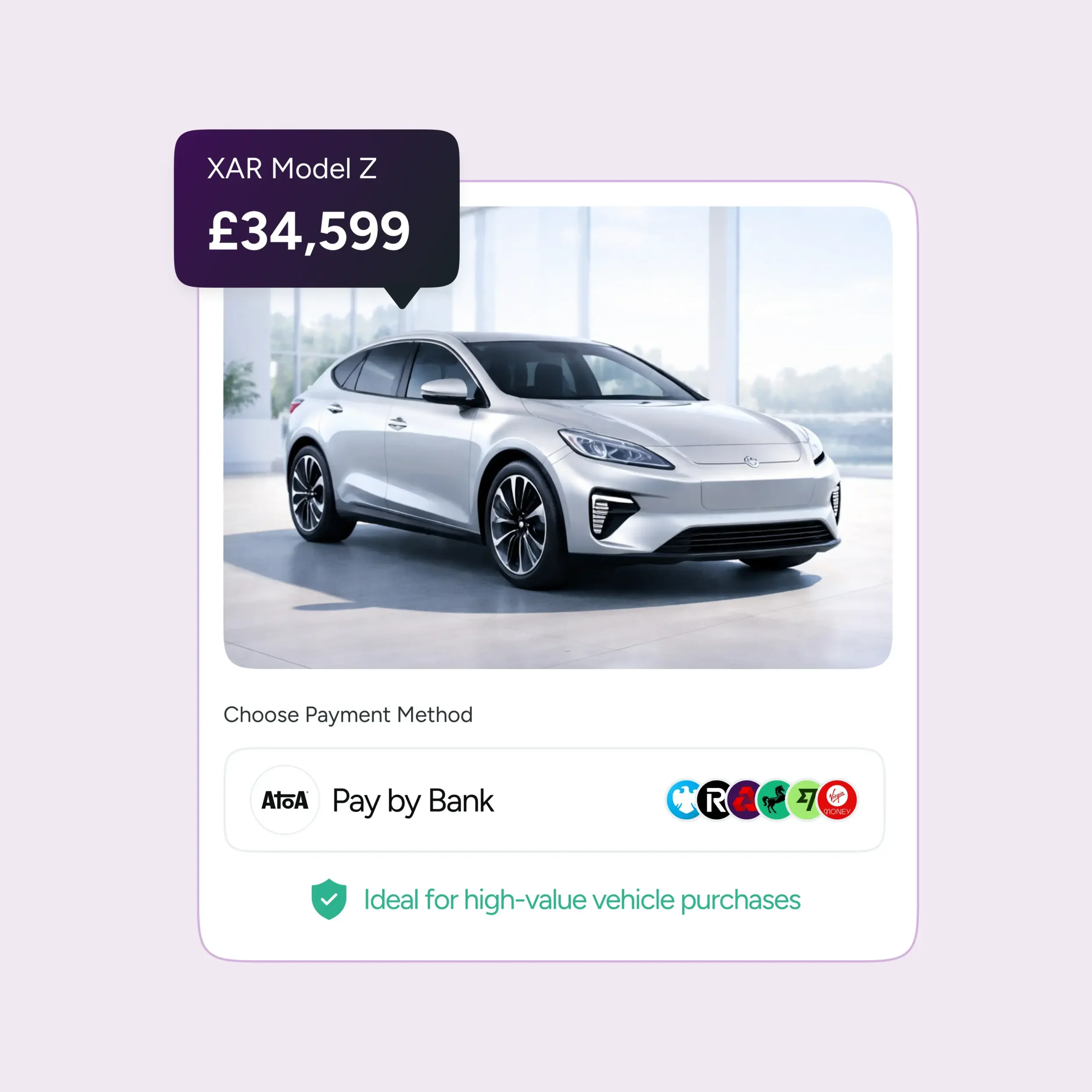
What that means for a business is that the rail is proven and the customer’s bank already supports it; the missing piece has been merchants presenting it. The sectors moving first are the ones with large tickets and a payment moment where the customer is already holding their phone: vehicle deposits, dental treatment plans, hotel bookings, trade orders, professional fees.
Can an A2A Payment be Refunded or Charged Back?
“No chargebacks” is the claim on every A2A page and it is true, but it needs finishing. A chargeback is a card-scheme process in which the customer’s bank reverses a payment without the merchant’s agreement. That process does not exist for a bank payment, because there is no scheme to run it. What still exists is the ordinary refund: a customer who is owed money asks the business, and the business sends it back from its dashboard, in full or in part, in seconds. The difference is who controls it. A refund is the business’s decision based on the evidence, while a chargeback is the bank’s decision, usually against the merchant, with a fee attached.
One consequence: the case for A2A is strongest where disputes are expensive and the business’s record-keeping is good. A dealership that can show the signed order and the delivery note has nothing to fear from a refund request and everything to gain from removing the chargeback route. Atoa’s own analysis of where card networks and open banking differ covers the liability side in more depth.
Limit on A2A Payments UK
Faster Payments carries payments up to £1 million per transaction under the scheme rules, but every bank sets its own daily and per-payment limits for its customers, and payment providers set their own. Atoa’s limit is £15,000 per payment. For a business taking a deposit, that is comfortably enough. For a full vehicle balance or a large trade invoice it may not be, in which case the payment is split across two approvals or the customer’s bank limit is the constraint, and the alternative is a card payment or a manually initiated bank transfer. Tell customers this upfront. It is the one point where an A2A payment is less convenient than a card, and the honest version wins more deals than the glossy one.
Security and authentication
An A2A payment is authenticated by the customer’s own bank, in the bank’s own app, using whatever the bank requires. In the UK that means Strong Customer Authentication on every payment: a biometric or a passcode on a registered device. No card number is typed, read out or stored, so there is nothing for a fraudster to reuse and nothing for the business to protect under PCI DSS. The provider initiating the payment must be authorised by the FCA for payment initiation services, and Atoa holds that authorisation (FRN 1007647). The remaining risk is the one that applies to any push payment, authorised push payment fraud, where a customer is tricked into paying the wrong payee. A QR code or link presented by the merchant removes the mistyped sort code, which is how most of that fraud happens. Atoa’s guide to A2A payment security covers the customer side.
How A2A Payments Land in your Accounts
A card payout arrives net of fees in a batch, days later, and somebody matches it to the sales. An A2A payment arrives individually, in seconds, with a reference, so reconciliation is a lookup rather than a reconstruction. Through Atoa’s integrations the payment posts against the invoice in Xero, QuickBooks or Sage, against the table or ticket in Epos Now, Tevalis, pointOne or TillTech, and against the patient record in Dentally, Carestack or SFD. For a finance team the practical effect is that end-of-day cash equals the day’s sales, and the fee is a line, not a mystery.
Where A2A payments work today, and where they do not
They work where the customer has a UK bank account and a phone in hand: in-person via QR on the terminal, remote via a link during a call, online at checkout, on an invoice, and for recurring collections as VRP arrives. They do not yet work for a customer paying from outside the UK, for anyone who wants to pay on credit (Pay Later covers that separately, through Abound), or above the provider’s payment limit. They are not a replacement for cards but a first option in front of them, which is why Atoa runs both.
What are the advantages and disadvantages of A2A payments?
For a UK business, the advantages are lower fees, faster money and less risk:
- Lower processing fees, because there is no interchange or card scheme fee. With Atoa, Pay by Bank starts at 0.7% + VAT.
- Settlement in seconds over Faster Payments, instead of one to three working days.
- Payments cannot be charged back through the card schemes.
- No card data to store, which takes the payment out of PCI DSS scope.
- Every payment is authenticated by the customer’s own bank.
The disadvantages are about reach:
- The customer needs a UK bank account and a phone with their Bank app.
- Bank and provider limits can cap large payments.
- There is no built-in credit, so a customer who wants to spread the cost needs a separate option such as Pay Later.
- UK consumers are less used to paying this way at the till than by card, so the business needs to present it clearly.
A2A Payments vs Bank Transfer vs Direct Debit: What is the Difference?
A manual bank transfer is an A2A payment the customer types themselves: same rails, but the sort code, account number and amount are keyed by the payer, and the merchant waits and matches. Direct Debit is a pull payment under the Bacs scheme, three working days to settle, with the Direct Debit Guarantee giving the payer an unconditional refund right. Open banking A2A is the push payment with everything pre-filled, settled in seconds, approved in-app. Card payments are the thing all three are being compared with. If a business is currently taking bank transfers for deposits, an A2A link is the same money on the same rail with the keying and the waiting removed. To see how that looks on your own volumes, book a demo.
Frequently asked questions
How do merchants accept account-to-account payments?
Through a regulated payment initiation provider such as Atoa. The customer scans a QR code at the terminal, opens a payment link sent by text or email, or chooses Pay by Bank at an online checkout; their Bank app opens with the amount and payee filled in, they approve it, and the money arrives in the business’s account in seconds.
How much do A2A payments cost compared with card payments?
With Atoa, Pay by Bank starts at 0.7% in person and 0.7% + 20p online, ex VAT, against UK card rates that typically start at 1.3% in person and rise online once gateway and fixed fees are added. There is no interchange or scheme fee, no chargeback fee and no card terminal rental needed to take it.
Can an A2A payment be charged back?
No. Chargebacks are a card-scheme process and there is no card scheme in an A2A payment, so the customer’s bank cannot reverse it without the business. A customer can still ask for a refund, which the business sends from its dashboard in full or in part.
Is there a limit on A2A payments in the UK?
The Faster Payments scheme allows up to £1 million per payment, but each bank sets lower limits for its customers and each provider sets its own. Atoa’s limit is £15,000 per payment; above that, split the payment or take a card.
What is the difference between an A2A payment and a bank transfer?
Both move money between bank accounts on the same rails. In a bank transfer the customer keys the sort code, account number and amount themselves and the business waits to match it; in an open banking A2A payment those details are pre-filled by the provider, the customer approves in-app, and the payment is confirmed to the business in seconds with a reference.
Sources
- UK Finance / Simon-Kucher, A2A payments in the UK: why consumer adoption lags, May 2025
- Open Banking Limited monthly data, reported by Finextra, 28 July 2026
- Payment Systems Regulator, Interchange Fee Regulation
- Pay.UK, Faster Payment System
- Financial Conduct Authority, Payment Services Regulations 2017 and Strong Customer Authentication
- GoCardless, What are account-to-account payments (push and pull definitions)
SHARE ARTICLE
Share link copied!