
Ready to get started?
Easily integrate next-generation payments and financial data into any app. Build powerful products your customers love.
SHARE ARTICLE


 Share link copied!
An EPOS (electronic point of sale) system rings up sales, tracks stock and reports across sites. But the line that costs the most over a three-year contract is usually the card processing fee associated with it. In this blog, we will compare the best EPOS systems used across the UK, what each one is good at, who processes your payments, and whether you get to choose it.
Key Takeaways
- The best EPOS system depends on your business type and scale, so match it to how you actually trade.
- Most quotes show hardware and software clearly and leave the payment processing fee in the small print, where it often becomes the biggest cost over three years.
- On £600,000 of card turnover, one percentage point on your processing rate works out at roughly £6,000 a year.
- With most systems you can keep the setup you have and choose your own payment provider. Some add an integration fee for it, so ask before you sign.
When an operator renews an EPOS contract, the monthly software fee and hardware costs are usually clear. The card processing rate can be easier to overlook, even though it applies to every card sale for the length of the agreement.
This is why the comparison here looks beyond software features. It explains what each system does well, which type of business it suits and how it approaches payments.
What Does An EPOS System Include?
EPOS stands for electronic point of sale. POS means point of sale and is the term used more widely outside the UK. In practice, people often use EPOS and POS to mean the same thing.
A modern EPOS system does much more than record a sale. Depending on the platform and plan, it may include:
- Stock control and supplier ordering
- Reporting across multiple sites
- Staff permissions and time tracking
- Offline functionality
- Kitchen or fulfilment displays
- Integrations with accounting and ecommerce software
Payment processing sits underneath these features. Unlike a fixed software subscription, processing is normally charged as a percentage of each transaction. A small difference in the rate can therefore have a noticeable effect on the total cost.
Comparison of the Best EPOS Systems for UK Businesses
Prices often vary by plan, site and hardware package, so the table describes the pricing model rather than quoting a single headline figure. Ask each provider for a complete quote that includes payment processing.
| System | Best for | Sector | Pricing model | Payments |
|---|---|---|---|---|
| Epos Now | All-rounder and strong app ecosystem | Retail and hospitality | Subscription per site, plus hardware | Open to third-party acquirers |
| Lightspeed | Deep analytics and multi-site | Retail and hospitality | Tiered subscription per site | Lightspeed Payments or third-party |
| Zonal | Enterprise pubs, bars and groups | Hospitality | Enterprise quote | Partner acquirers |
| Tevalis | Multi-site hospitality and leisure | Hospitality | Enterprise quote per site | Open; Atoa integration live |
| ICRTouch | Established UK dealer-supported tills | Retail and hospitality | One-off licence via dealer, plus support | Via dealer and acquirer |
| pointOne | Casual dining, kiosks, counter speed | Hospitality | Subscription per site | Open; Atoa integration live |
| Till Tech | Takeaway-led and multi-location | Hospitality | Subscription per site | Open; Atoa integration live |
| Shopify POS | Retail that also sells online | Retail | Shopify plan plus POS | Shopify Payments default, third-party allowed |
| Clover | Flexible hardware bundles | Retail and hospitality | Hardware plus monthly, often via reseller | Usually bundled processing |
| Square | Simplest all-in-one setup | Retail and hospitality | Free tier, pay-as-you-go hardware | Bundled Square processing |
The Top EPOS Systems in The UK
1. Epos Now
Epos Now is a flexible option for established retail and hospitality businesses that want a flexible till with a large app store and UK dealer support. It offers inventory management, reporting and a large marketplace of integrations and add-ons.
Its broad feature set makes it a useful all-rounder, although customer experiences with support and sales can vary. Epos Now supports third-party payment providers. Businesses can also display an Atoa Pay by Bank QR code at checkout without needing a direct integration.
2. Lightspeed
Lightspeed works well for multi-site operators that need detailed reporting and strong inventory management. Its tools can provide a clear view of stock and performance across several locations. Its reporting and stock tools are among the best in this list, and it scales well.
The platform can take longer to learn than simpler systems, and costs can rise as additional modules are added. Businesses can use Lightspeed Payments or connect a supported third-party provider.
3. Zonal
Zonal is designed for larger hospitality businesses, including pub, bar and restaurant groups. It offers table management, loyalty tools and controls for managing an estate from one platform.
Its hospitality focus is a strength for larger operators but may make it more than a small, single-site business needs. Payments are handled through partner acquirers, so businesses should review the processing arrangement and contract terms alongside the EPOS proposal.
4. Tevalis
Tevalis serves multi-site hospitality and leisure businesses. Its features include self-service kiosks, estate-wide reporting and tools designed for more complex operations.
It is better suited to hospitality groups than general retailers. Tevalis has a live Atoa integration, allowing businesses to accept Pay by Bank and card payments through the platform.
5. ICRTouch
ICRTouch is an established UK system sold and supported through a network of local dealers. Its TouchPoint EPOS software is known for reliable offline performance, which can be valuable in busy venues with inconsistent connectivity.
The interface is more traditional than some newer cloud-based systems. Payment arrangements usually depend on the dealer and acquiring partner, so ask for a full breakdown of processing rates, support costs and contract terms.
6. pointOne
pointOne focuses on casual dining, kiosks and counter-service businesses where speed is important. It offers integrations designed for hospitality operations and busy service environments.
It is more specialised than a general retail system. pointOne has a live Atoa integration, enabling Pay by Bank payments through the EPOS platform.
7. Till Tech
Till Tech is aimed at takeaway and multi-location hospitality businesses. Online ordering forms a central part of the platform, making it relevant to operators that manage delivery and collection alongside in-store sales.
Its specialist hospitality features may be less relevant to general retail. Till Tech also has a live Atoa integration.
8. Shopify POS
Shopify POS is a natural option for retailers that already sell through Shopify. It brings in-store and online products, orders, stock and customer records into one system.
The close connection with ecommerce is its main advantage. Hospitality businesses may find it limited for functions such as table management and kitchen operations. Shopify Payments is the default option, although the platform permits supported third-party providers.
9. Clover
Clover offers several hardware configurations and an app marketplace. Banks and resellers commonly provide it as part of a broader payment package.
The choice of devices is useful, but the payment contract may be tied to the reseller or acquiring provider. Check the processing rate, minimum term, exit charges and ownership of the hardware before committing.
10. Square
Square is straightforward to set up and offers transparent pricing with a free software tier. It is well suited to smaller businesses, counter service and operators that want to begin taking payments quickly.
Square bundles payment processing with the system, so businesses cannot independently choose the card processor. It is generally a better fit for a simple setup than for a large or operationally complex estate.
What Hospitality Businesses Need From an EPOS System
Hospitality places different demands on an EPOS system. Restaurants, pubs and cafés may need:
- Table and tab management
- Courses sent to the kitchen at the right time
- Ingredient or measure-level stock tracking
- Tronc and tip management
- Delivery-platform integrations
- Payment at the table
For payment at the table, a QR code can allow guests to pay through their banking app without going to a fixed terminal. Staff can remain at the table while the customer completes the payment.
What Retailers Need From an EPOS System
Retail businesses tend to place more emphasis on inventory and order management. Important features may include:
- Product variants and SKU management
- Purchase orders and supplier returns
- Stock transfers between branches
- Click-and-collect
- Online and in-store stock synchronisation
- Loyalty tools
Retailers that also sell online should examine how accurately and quickly the EPOS system synchronises with their ecommerce store. Reliable stock data can prevent overselling and reduce manual reconciliation.
How Much Does an EPOS System Cost?
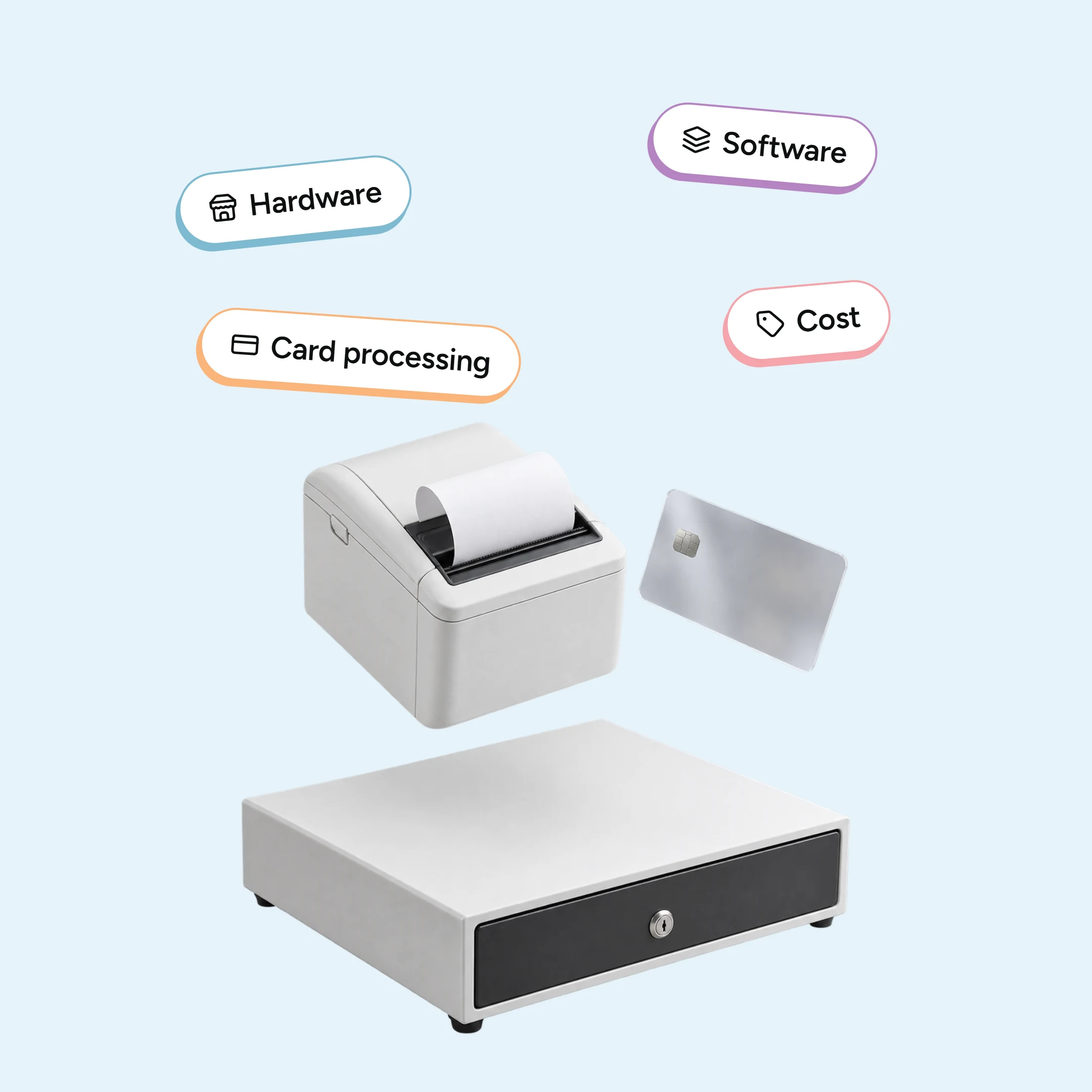
An EPOS bill normally has three main parts:
- Hardware: The touchscreen or terminal, receipt printer, scanner and other equipment, purchased outright or financed.
- Software: A monthly or annual subscription, usually charged per site or terminal.
- Payment processing: A fee applied to each card transaction.
Businesses often compare the first two costs carefully and give less attention to the third. However, processing can become the largest expense over the full contract.
For example, one percentage point on £600,000 of annual card turnover equals £6,000 a year. Over a three-year contract, that becomes £18,000. The precise cost will depend on the provider, card mix and pricing model, but the example shows why processing rates deserve the same scrutiny as hardware and software fees.
Do You Have to Use Your EPOS Provider’s Card Processing?
In many cases, yes, although the arrangement differs between systems.
Some EPOS providers include their own payment processing by default. Others allow you to connect a separate provider. A provider may also charge an integration or per-transaction fee when you use a third party.
Before signing, ask these:
- Can I keep this EPOS system and choose a different payment provider?
- Does using a third-party provider add an integration fee?
- Will the EPOS system continue working if I change acquirer?
- Are there minimum terms or exit charges?
This makes it easier to compare the total contract cost and avoid becoming tied to an unsuitable processing arrangement.
Using Atoa With an Existing EPOS System
Atoa works alongside existing EPOS systems rather than requiring a business to replace its current setup.
Customers can pay by scanning a Pay by Bank QR code displayed at checkout. They approve the payment in their banking app using Face ID, a fingerprint or passcode. Payments are sent through Faster Payments and typically arrive within seconds.
Pay by Bank pricing starts from 0.7% plus VAT. Because the payment uses Open Banking rather than a card network, it does not follow the card chargeback process. Refunds and genuine disputes can still be managed through the Atoa Business app. Standard support is available for individual transactions of up to £15,000, with higher limits available on request.
Atoa also offers card payments from 1.3% through an Atoa card terminal. Pay Later is available for eligible larger purchases through Abound, with Atoa acting as the introducer and Abound as the lender. Businesses can use the same Atoa account for in-person and online payments, payment links and invoices.
Tevalis, pointOne and Till Tech are among the platforms with live Atoa integrations. In these systems, a completed payment can close the relevant table or tab as a standard tender type. Businesses without a direct integration can use an Atoa QR code alongside their existing checkout setup.
How to Choose the Best EPOS System for Your Business
Here’s the simple way to know which EPOS is best suited for your business.
Calculate the complete three-year cost
Add the hardware, software subscription and estimated payment processing charges. For a multi-site business, include every location and terminal. Compare the total rather than the headline monthly price.
Match the system to the way you trade
A takeaway, pub group and omnichannel retailer will use different features. Start with the tasks staff perform every day and identify which functions are essential.
Check your integrations
Confirm that the system works with your accounting software, ecommerce platform and preferred payment provider. Ask whether any integration attracts an additional fee.
Plan for downtime and support
Check whether the EPOS system continues working offline, when UK support is available and how quickly the provider replaces faulty hardware. These details matter most when something goes wrong during a busy trading period.
Most providers offer a demonstration or trial. Shortlist two or three systems and test them against realistic scenarios before making a decision.
Conclusion
Choosing an EPOS system involves more than comparing features and monthly software fees. The system needs to fit the way your business operates, but the payment arrangement also deserves close attention because it can become the largest cost over time.
Build a shortlist, compare the full three-year cost and confirm whether you can choose or change your payment provider. Doing that work before signing gives you a clearer view of the commitment and reduces the risk of unexpected charges later.
Frequently Asked Questions
What is the best EPOS system in the UK?
The best option depends on your business model and size. Epos Now and Lightspeed are flexible all-rounders. Zonal and Tevalis suit larger hospitality groups, while pointOne focuses on fast counter service. Shopify POS is a strong option for retailers that also sell online.
How much does an EPOS system cost in the UK?
The total cost usually includes hardware, a software subscription and payment processing. Hardware may be purchased or financed, while software is often charged monthly per site. Processing applies to each card transaction and can become the largest expense over a multi-year contract.
What is the difference between EPOS and POS?
There is little practical difference. EPOS means electronic point of sale and is commonly used in the UK. POS means point of sale and is more widely used internationally.
Can I choose my own payment provider?
Many systems allow third-party payment providers, but some bundle processing or charge an integration fee. Check the provider’s rules and contract terms before signing.
Which EPOS systems work with Atoa?
Tevalis, pointOne and Till Tech have live Atoa integrations. Businesses using other EPOS systems can accept Atoa Pay by Bank payments through a QR code displayed at checkout.
Can I keep my EPOS system and change payment provider?
Often, yes. Review your existing contract for exit conditions and ask the EPOS provider whether it charges for third-party integrations. Test the new payment setup before moving all transactions across.
Source
SHARE ARTICLE
Share link copied!