
Ready to get started?
Easily integrate next-generation payments and financial data into any app. Build powerful products your customers love.
SHARE ARTICLE


 Share link copied!
When a business tries to set up online payments for the first time, it compares a few providers, and two terms keep appearing, often used as if they mean the same thing, payment gateway and payment processor. They describe two different jobs in a payment, and knowing which is which helps you read a provider’s pricing, understand where a transaction can fail, and judge whether you’re paying for one service or three. In plain terms, a payment gateway captures and securely transmits the payment details from your checkout, while a payment processor moves the transaction and the funds between the customer’s bank, the card schemes and your account. The gateway is the front door the customer walks through, and the processor is the plumbing that works behind it. In this blog, let’s see what each service does, how they work together and what to check before choosing a payment setup.
Difference Between Payment Gateway vs Payment Processor
A payment gateway, payment processor and acquirer can all be involved in the same card payment, but each performs a different role. The gateway connects the checkout to the payment system, the processor transmits the transaction messages, and the acquirer enables the business to accept cards and receive the proceeds. Here’s how the three differ:
| Comparison | Payment Gateway | Payment Processor | Acquirer |
|---|---|---|---|
| What it does | Captures and securely transmits the payment details | Moves the transaction and funds between banks and card schemes | Holds your merchant relationship and settles funds to you |
| Where it sits | The front door, at your checkout or terminal | The plumbing, behind the scenes | The settlement layer |
| Who provides it | A gateway provider or all-in-one platform | A processor or all-in-one platform | An acquiring bank or all-in-one acquirer |
| Customer-facing? | Yes, it is the checkout they see | No | No |
| Example | A hosted checkout page or a terminal | The engine that routes the transaction for authorisation | The regulated party that pays you out |
What Is A Payment Gateway?
A payment gateway is the technology that captures a customer’s payment details at the point of sale (POS) and transmits them securely for authorisation. Online, it’s the checkout page or the embedded payment form that collects the card number and encrypts it. In person, the equivalent role is played by the software inside the card terminal. The gateway’s job is to move payment data safely and return an “Approved” or “Declined” status. But it does not move the money itself.
Payment gateways typically handle the security-sensitive steps around a card payment like encrypting card data, tokenising it so the raw number isn’t stored, and running checks such as CVV and address verification. Reducing how much card data a business touches directly is also central to meeting the Payment Card Industry Data Security Standard (PCI DSS).
What Is A Payment Processor?
A payment processor is the service that routes the transaction between the banks and card networks and handles the movement of funds. Once the gateway passes the encrypted details on, the processor sends the authorisation request through the relevant card scheme (such as Visa or Mastercard) to the customer’s bank, returns the decision, and then manages the later stages that actually move the money into the merchant’s account.
In practice the processor works on behalf of, or alongside, the merchant acquirer, the bank or institution that holds the merchant’s account and is ultimately responsible for settling funds to the business. Sometimes the acquirer and processor are the same company and sometimes separate. The processor is also usually where refunds, disputes and chargebacks are managed operationally.
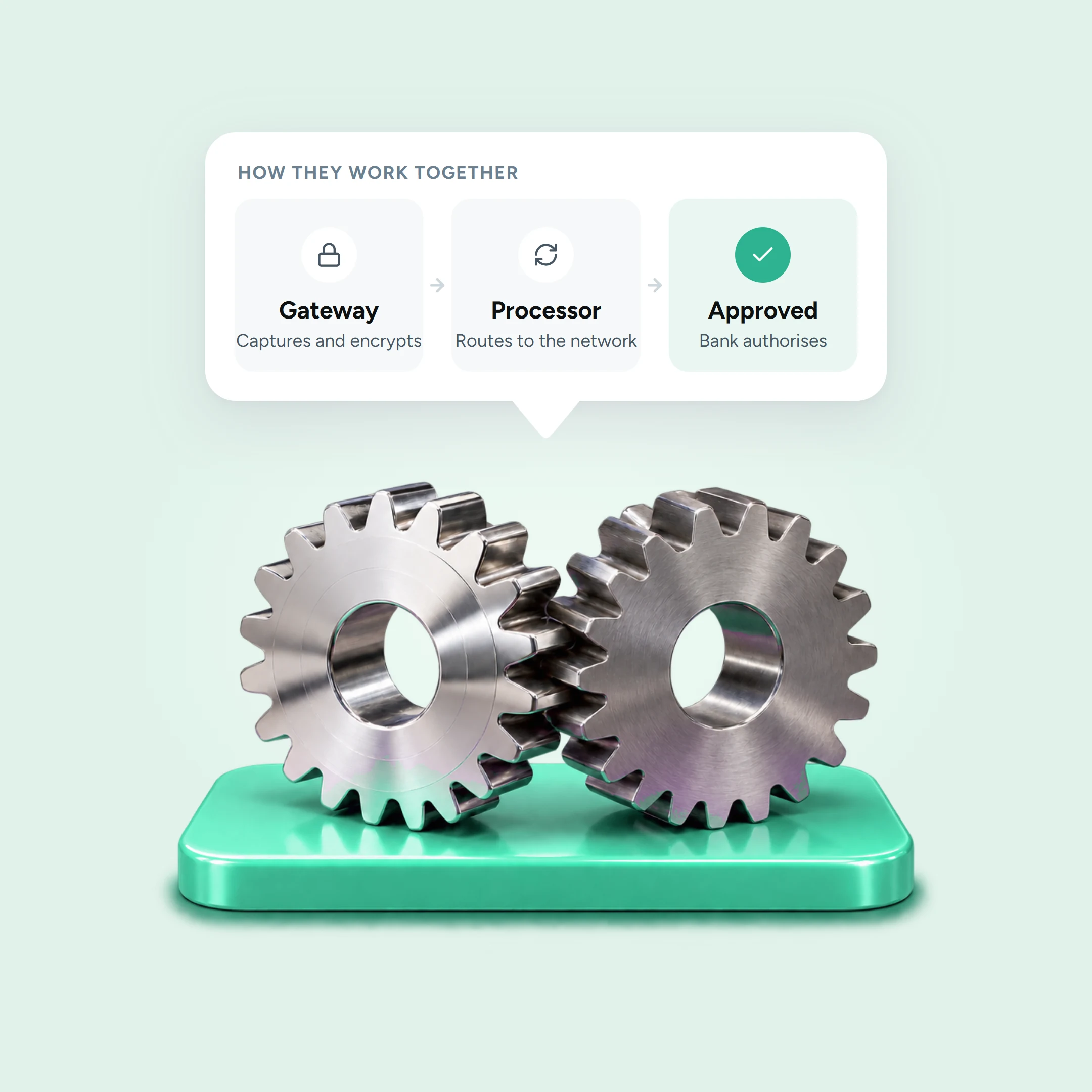
How a Payment Gateway and Processor Work Together?
Consider a customer paying by card on an ecommerce website:
- The customer enters their card details into the checkout or uses a stored card or digital wallet and makes the payment.
- The payment gateway securely captures the payment data and sends the transaction request to the processor or acquiring side.
- The payment processor helps route the request through the acquirer and the relevant card network, such as Visa or Mastercard, to the customer’s card issuer.
- The issuing bank checks factors such as the card status, available funds or credit and its fraud controls before approving or declining the request.
- The response travels back through the card network and acquiring side. The processor passes it to the gateway, which tells the merchant’s website or app what happened.
- Approved transactions are cleared and settled. Transaction records are later exchanged and reconciled, and the amounts due move through the card-payment system.
- The acquirer or payment provider pays the card proceeds into the merchant’s nominated business bank account according to the agreed payout schedule, after applicable fees and adjustments.
Only the authorisation stage normally happens within the few seconds a customer waits at checkout. An approval confirms that the issuer has authorised the transaction; it does not mean the money has already arrived in the merchant’s bank account.
Where the Acquirer and Merchant Account Fit
The gateway and processor are only two parts of a card payment. The acquiring side connects the merchant to the card-payment system and manages the commercial relationship required to accept cards.
An acquirer is the financial institution that enables a merchant to accept card payments and submits transactions into the relevant card networks. It receives settlement on the merchant’s behalf and is responsible for obligations that can include merchant underwriting, monitoring and scheme compliance.
A merchant account is part of the acquiring setup through which card-payment proceeds are accounted for before payout. Some businesses have a dedicated merchant account, while others use a pooled or aggregated model supplied by a payment facilitator or all-in-one provider.
Do You Need Both a Gateway and a Processor?
An online card payment normally needs all three, a payment gateway, processor and acquirer but that does not mean a business must buy them separately. Many payment providers package them together and give the merchant one integration, agreement and reporting interface.
A business might use separate providers when it has an established acquiring relationship, needs a specialist gateway or operates across markets that require different processing connections. This can offer more control, but it also introduces more contracts, integrations and points of responsibility.
For a mid-sized business, a combined provider is usually easier to implement and manage. This is where Atoa fits, an omni-channel payment provider that covers both card payments (provided by Rapyd) and Pay by Bank, and feeds straight into your online checkout, so a mid-market business runs one platform rather than three.
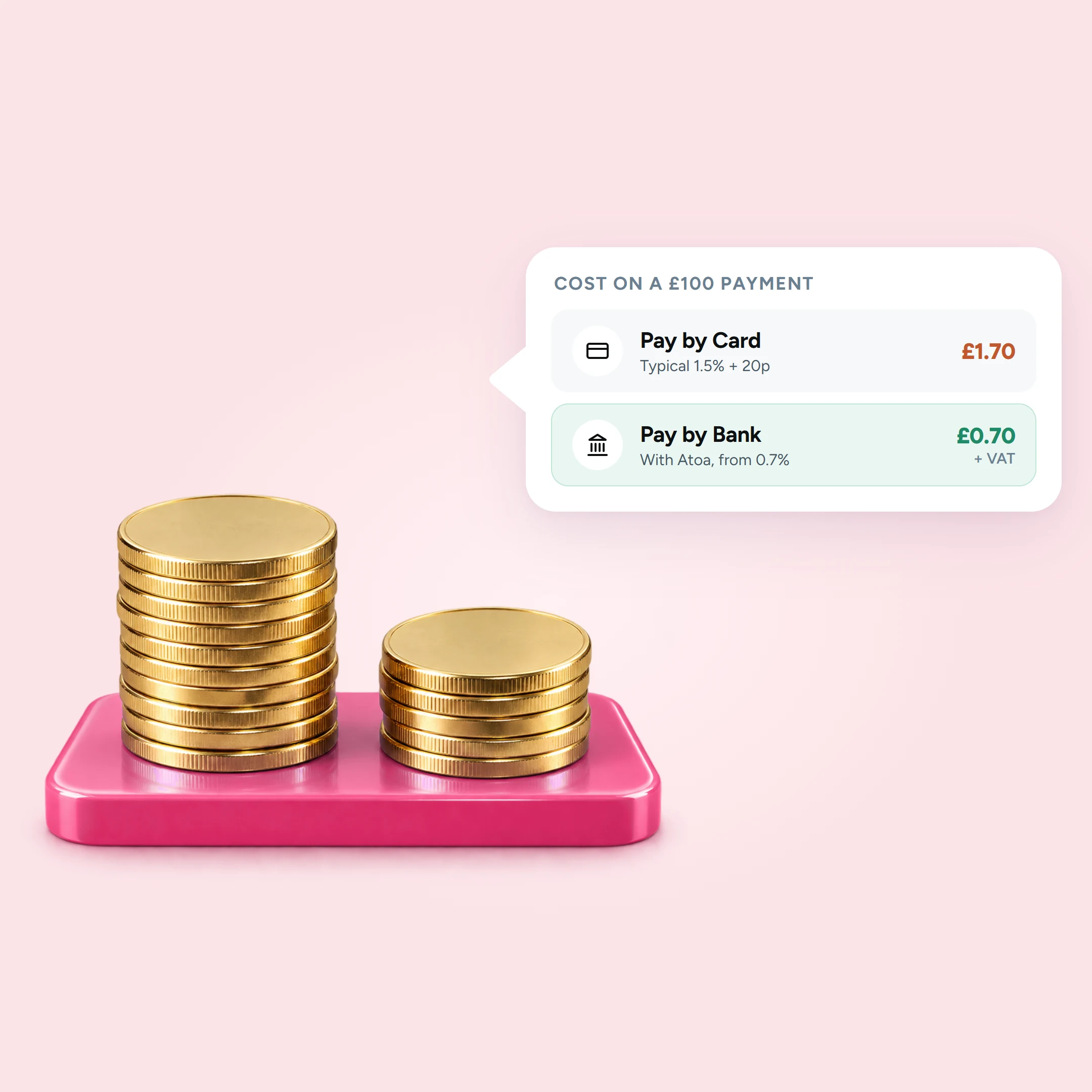
It is also worth noting that Pay by Bank uses open banking, where the payment moves account-to-account directly between the customer’s bank and yours, with no card scheme in the middle. That is why it typically settles within seconds via Faster Payments and is not subject to card-scheme chargebacks (though refunds, disputes and fraud processes can still apply). AtoA’s rate starts from 0.7% + VAT, against cards from 1.3%. You can see the detail on the pricing page.
Frequently Asked Questions
What is the difference between a payment gateway and a payment processor?
A gateway captures and securely transmits the payment details from your checkout, while a processor moves the transaction and the funds between the banks and card schemes. The gateway is the front door the customer sees, and the processor is the plumbing behind it. Many providers offer both together.
Do I need both a payment gateway and a payment processor?
For card payments, yes, and you also need an acquirer to settle the funds. In practice most businesses get all three from a single all-in-one provider rather than connecting separate vendors, which is simpler to set up and manage.
Where does the acquirer fit in?
The acquirer is the regulated party that holds your merchant relationship, receives the approved funds and settles them to your account. In the flow, the gateway captures the payment, the processor moves it, and the acquirer pays you out.
Do I need a gateway for Pay by Bank?
No. Pay by Bank is account-to-account through open banking, so there is no card gateway or processor involved. The money moves directly between the customer’s bank and yours, typically settling within seconds and not subject to card-scheme chargebacks.
If you would rather not wire up a gateway, a processor and an acquirer separately, see how Atoa’s merchant services bring them together for card and Pay by Bank, or book a demo.
Sources
Atoa Payments Limited is authorised by the Financial Conduct Authority under the Payment Services Regulations 2017 as an Authorised Payment Institution to provide account information services and payment initiation services (FRN 1007647). Card payment services are provided by Rapyd Payments Limited, which is authorised by the FCA (FRN 900688). Atoa is ISO 27001 certified and SOC 2 attested.
- Card payments and the UK payments landscape: UK Finance
- Card data security requirements (PCI DSS), which gateways must meet: PCI Security Standards Council
- Payment institution authorisation in the UK: Financial Conduct Authority
SHARE ARTICLE
Share link copied!