
Ready to get started?
Easily integrate next-generation payments and financial data into any app. Build powerful products your customers love.
SHARE ARTICLE


 Share link copied!
Every time a customer pays you by card, a small part of that sale disappears before the money reaches your account. A part of the charge may go to the bank that issued the customer’s card, another part to the card scheme, and another to the company providing the merchant’s payment service. The interchange fee is one of those components, and understanding it helps explain why two apparently similar card payments can cost a business different amounts.
This matters most when you are comparing providers or trying to understand why your effective card rate has increased. A low advertised rate may apply only to domestic consumer cards, while commercial, premium or overseas-issued cards attract different costs. This guide explains where interchange goes, which UK transactions are capped, how providers present the charges and what a business can realistically do to reduce its total payment bill.
What Is An Interchange Fee?
An interchange fee is the amount paid by the merchant’s acquirer to the bank or financial institution that issued the customer’s card. It applies to most payments made through four-party card systems such as Visa and Mastercard.
If a customer uses a debit card to pay £100. The merchant does not send an interchange payment separately. Instead, the fee forms part of the merchant service charge collected under the business’s card-processing agreement. The acquirer accounts for the interchange due to the issuer through the card-payment system, while the merchant receives the remaining proceeds according to its payout terms.
The fee helps support the issuer’s role in the transaction, which includes issuing the card, maintaining the customer’s account and responsibilities connected with authorisation, fraud and cardholder protections. The card scheme sets the interchange categories and rates, subject to any legal caps that apply. The merchant’s payment provider does not normally decide the underlying interchange rate.
How Interchange Fits Into the Cost of a Card Payment
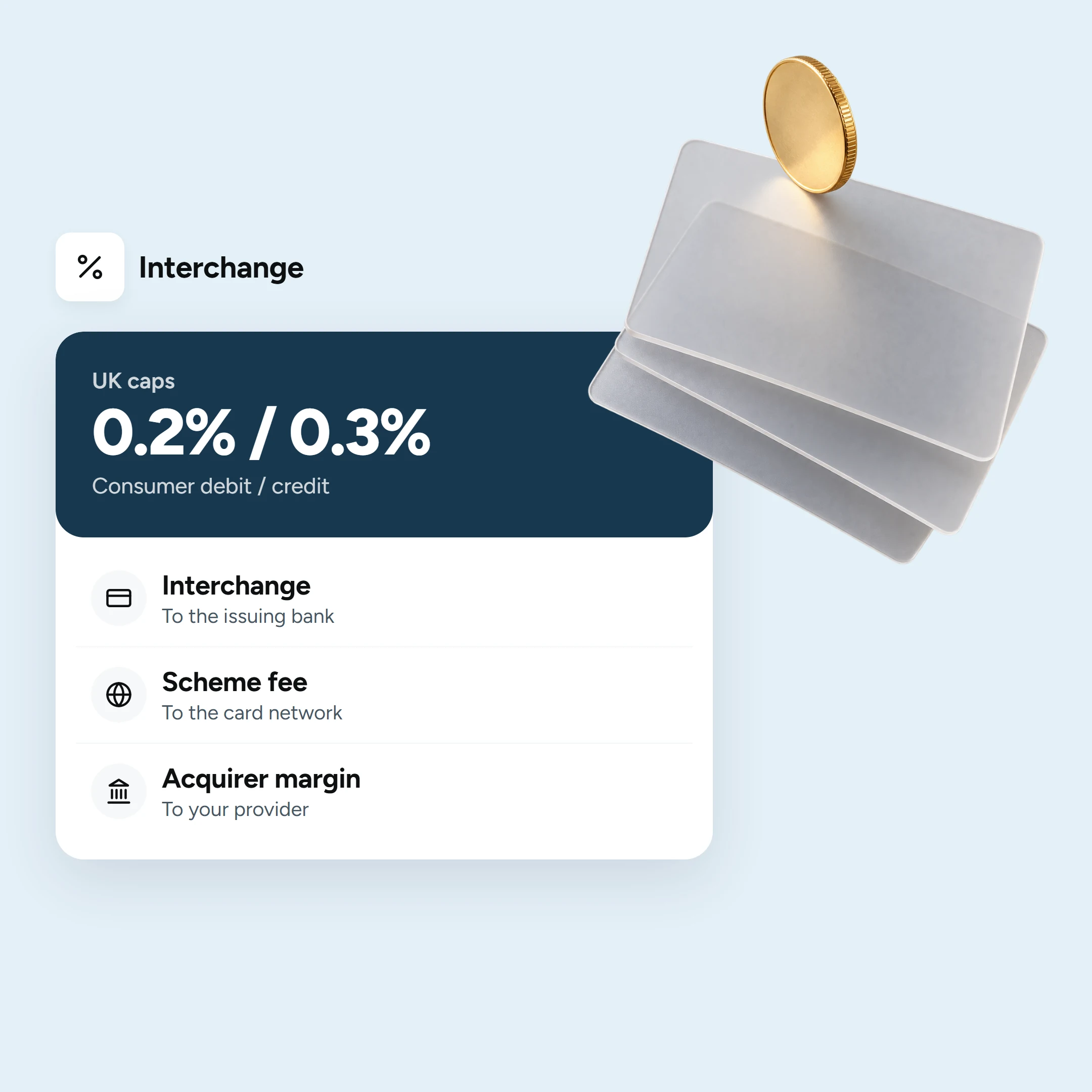
Interchange is only one part of the fee charged when a customer pays by card. The transaction cost normally contains three main components:
- Your acquirer pays interchange amount to the bank or financial institution that issued the customer’s card. The applicable rate depends on the card and transaction type.
- Visa or Mastercard charges fees for carrying the transaction through its network and providing the rules and infrastructure used by participating banks.
- Your provider charges for its services. This part covers the acquiring, processing and other payment services included in your agreement. Unlike interchange, the provider has control over its own pricing.
These components are usually collected together through the merchant service charge (MSC). Some providers use the term merchant discount rate, or MDR, for the percentage charged on each card transaction. However, the stated rate may not include separate costs such as terminal rental, gateway access, authorisation fees, refunds, chargebacks or currency conversion.
This is why two businesses using the same provider may not pay the same effective rate. A business taking mostly UK consumer debit cards will usually have a different cost profile from one receiving a large share of commercial or overseas-issued cards. When comparing providers, use your actual card mix and include every contractual charge rather than judging the offer by its headline percentage.
UK Interchange Rates And Caps
The UK Interchange Fee Regulation caps interchange on consumer-card transactions where the merchant, acquirer and card issuer are all located in the UK. Where the regulation applies, the current caps are:
| Card Category | Maximum Interchange |
| Domestic consumer debit and prepaid cards | 0.2% of the transaction value |
| Domestic consumer credit cards | 0.3% of the transaction value |
These caps took effect in December 2015. They limit the interchange component, not the full merchant service charge. A provider can still charge for acquiring, processing, terminals, gateways and other services included in the merchant’s contract.
Interchange++ vs Blended Pricing
The interchange rate is only part of the cost; the way a provider presents the bill also affects how easily a business can understand it. The two pricing models most merchants encounter are Interchange++ and blended pricing.
How Interchange++ pricing works
Interchange++, often referred to as IC++, separates the three main components of a card charge:
- The interchange paid to the issuer
- The card-scheme fees
- The provider’s acquiring or processing charge
This makes it easier to see which costs are passed through and how much the provider adds. The monthly total will still move as the business’s card mix changes, so IC++ is transparent rather than perfectly predictable.
How Blended Pricing Works
Blended pricing combines several components into one stated rate, such as a percentage plus a fixed amount for each payment. The provider absorbs some variation between card types and charges the merchant under the agreed pricing categories.
This model makes day-to-day costs easier to estimate, but it provides less visibility into interchange, scheme fees and provider margin. It can be convenient for a business with straightforward payment needs, yet a merchant processing substantial volume may want to know whether lower-cost transactions are subsidising more expensive card types within the blend.
| Comparison | Interchange++ | Blended pricing |
| Can the merchant see the main cost components? | Yes, although statements can be complex | Usually not in full |
| Does the rate vary with the card mix? | Yes | The provider may group transactions into one or more fixed categories |
| Is the monthly bill easy to forecast? | Less so, because underlying costs vary | Usually easier |
| Who may find it useful? | Businesses with higher volumes and the ability to analyse statements | Businesses prioritising simple, predictable pricing |
Neither structure is automatically cheaper. Compare both using your own transaction data, including domestic debit, domestic credit, commercial, international and card-not-present volumes. Our guides to card-processing fees and card payments and processing fees explain the other charges to include.
Why Pay by Bank Avoids Interchange
Here is the part that changes the maths rather than just explaining it. Interchange and scheme fees exist because a card payment travels across the card networks, moving between the issuing bank and the acquirer with the schemes in the middle. A payment that never touches those rails cannot incur those fees at all.
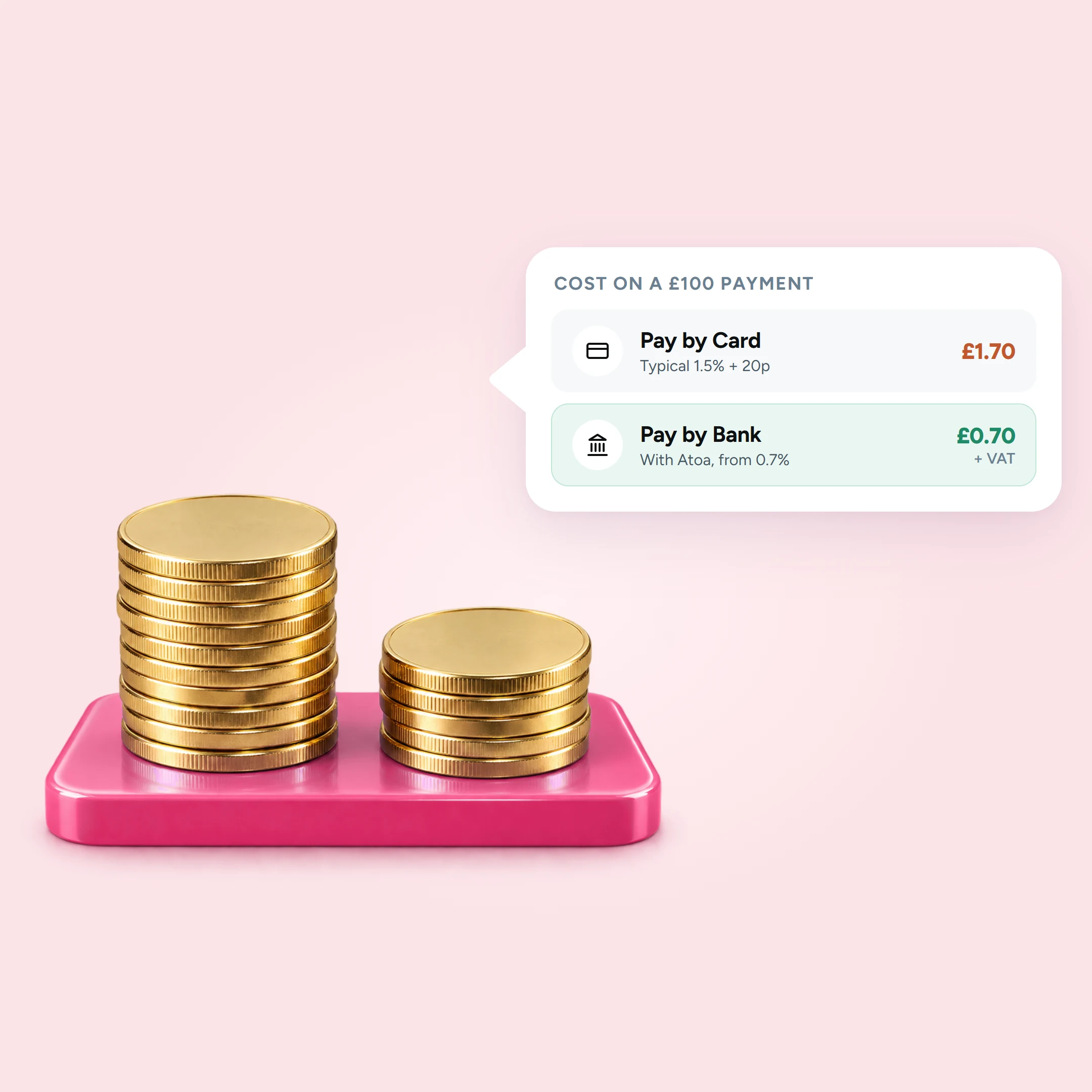
Pay by Bank works exactly that way by running on open banking, so the money moves account-to-account, directly from the customer’s bank to yours over Faster Payments, with no card scheme sitting in between. That structure removes interchange and scheme fees from the equation and leaves only a single processing rate, which is why account-to-account payments are typically cheaper than card payments for the same sale. With Atoa, Pay by Bank starts at 0.7% + VAT, against cards from 1.3%, up to 50% lower than typical card fees, and it settles in 3 to 6 seconds over Faster Payments with no card-style chargebacks. See pricing.
How To Reduce Your Interchange And Card Costs
Interchange rates are set by the card schemes and cannot usually be negotiated by the merchant. However, you can reduce the total amount your business pays to accept payments:
- Interchange++ shows you the margin your provider adds, choose a pricing which is easier to negotiate than a blended rate.
- Understand your card mix. Commercial and international cards cost more, so know how much of your volume they make up.
- Offer a lower-cost method like adding Pay by Bank alongside cards moves a share of payments off the interchange-bearing card rail entirely.
- Surcharging consumer cards is restricted in the UK, so steering customers to a lower-cost option is usually the compliant route.
Frequently Asked Questions
Why did my cross-border card fees go up?
If you accept cards from customers in the EEA, interchange on those transactions rose sharply after Brexit, when the EU caps stopped applying to UK–EEA payments and the schemes raised online consumer rates to around 1.15% on debit and 1.5% on credit. The Payment Systems Regulator is reviewing these fees, but no new cap is in force yet, so check the current position.
Who sets interchange fees?
The card schemes, Visa and Mastercard, set interchange rates, and the fee is paid to the customer’s issuing bank. Your payment provider does not set interchange and cannot discount it, only its own margin.
What are UK interchange fee caps?
UK domestic consumer interchange is capped at 0.2% on debit cards and 0.3% on credit cards, under the UK Interchange Fee Regulation in force since 2015. Commercial cards and non-EEA cards are exempt and cost more.
What is the difference between interchange, scheme fees and the merchant discount rate?
Interchange goes to the issuing bank, scheme fees go to Visa or Mastercard for using their network, and the acquirer margin is your provider’s charge. Added together they make the merchant discount rate (MDR), the total card fee you pay.
Does Pay by Bank have interchange fees?
No. Pay by Bank is account-to-account through open banking, so it does not touch the card networks. There is no interchange and no scheme fee, which is why Atoa Pay by Bank starts at 0.7% + VAT.
How can I lower my interchange and card fees?
You cannot cut interchange itself, but you can choose a transparent Interchange++ model, understand your card mix, and add a lower-cost method like Pay by Bank so a share of payments moves off the card rail.
Sources
Atoa Payments Limited is authorised by the Financial Conduct Authority as an Authorised Payment Institution (FRN 1007647); card services are provided by Rapyd Payments Limited (FRN 900688).
- UK interchange caps and the UK–EEA cross-border interchange market review, including the decision not to proceed with the interim cap (Payment Systems Regulator, October 2025). The 15 January 2026 High Court ruling on the PSR’s power to impose a cap: R (Mastercard Europe SA) v Payment Systems Regulator [2026] EWHC 64 (Admin), reported by Reuters.
- UK card payments context: UK Finance
SHARE ARTICLE
Share link copied!