
Ready to get started?
Easily integrate next-generation payments and financial data into any app. Build powerful products your customers love.
SHARE ARTICLE


 Share link copied!
A finance lead compares last month’s statement with the payment provider’s quoted rate. The provider quoted 1.5%, but the statement shows a rate closer to 2.1%. So, where did the extra cost come from? Several smaller charges created the difference.
This guide explains UK payment gateway fees in 2026 covering the pricing models, additional charges and real transaction costs. You will also learn how to compare providers using your own figures.
The UK payment gateway fees often range from 1.4% to 2.9% per card transaction. Many providers also charge a fixed fee of 20p to 30p. Monthly charges, authorisation fees and card uplifts can increase your effective rate. Comparing the total cost provides a clearer view than headline pricing.
Key Takeaways
- Headline rates show only part of the total payment cost.
- Your effective rate offers the clearest comparison between payment providers.
- Transaction volume and card mix influence the best pricing model.
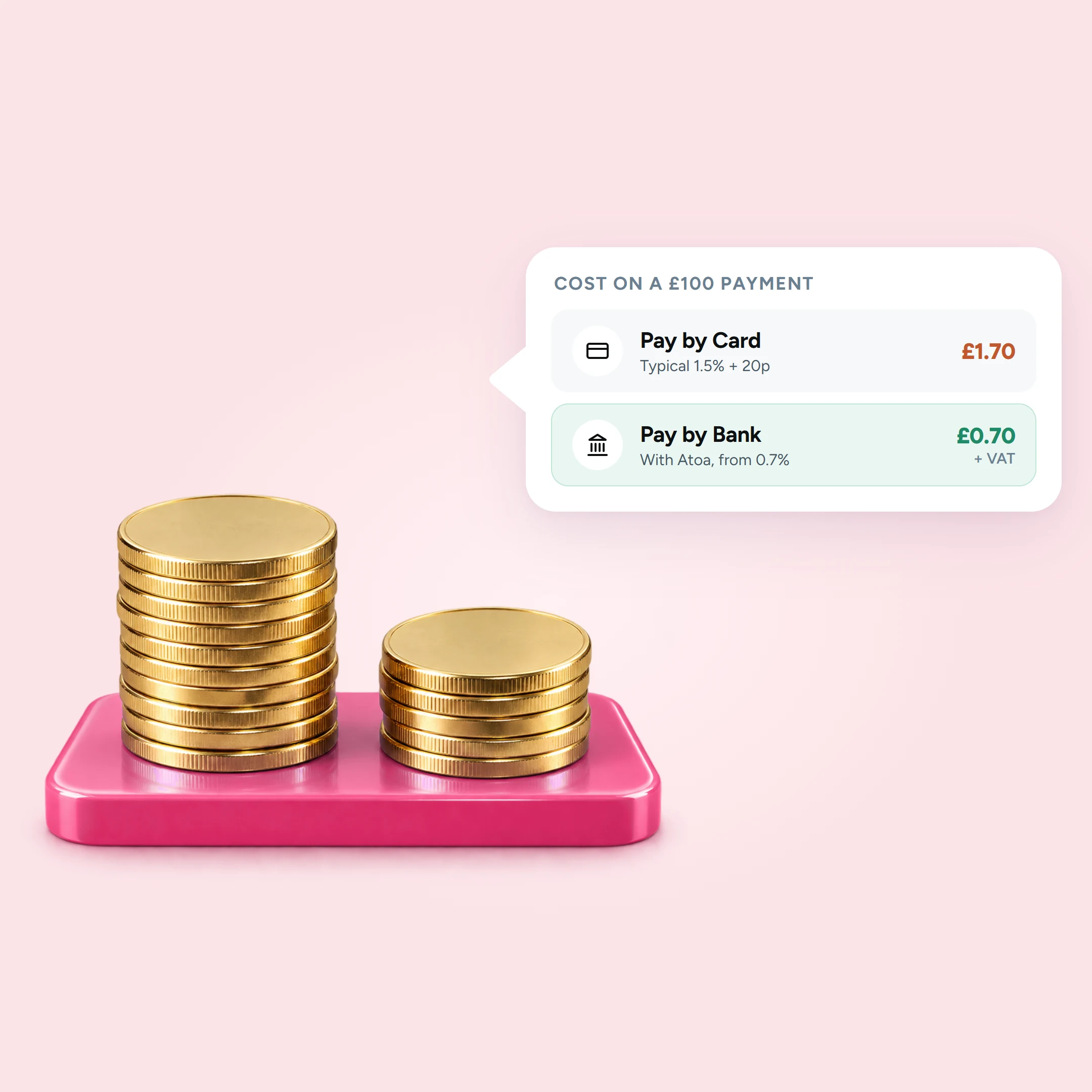
- Pay by Bank avoids card interchange and card-scheme fees.
- Ask providers to price your recent card mix before signing.
How Is Payment Gateway Pricing Structured?
Payment gateway pricing usually follows one of three models. Understanding each model makes provider quotes easier to compare.
A payment gateway securely sends transaction data for authorisation. An acquirer settles the approved funds into your business account. One provider may perform both roles within the same service.
| Pricing model | How it works | Usually suits | Main consideration |
|---|---|---|---|
| Blended | One flat rate applies across eligible card payments | Businesses wanting simple and predictable pricing | The average rate can hide expensive card types |
| Interchange++ | Interchange, scheme fees and provider margin appear separately | Higher-volume businesses with a predictable card mix | Monthly costs can vary with card usage |
| Subscription plus transaction fees | A monthly payment gives access to lower transaction rates | Businesses processing a steady monthly volume | Savings begin after reaching the break-even volume |
Blended pricing keeps statements relatively simple. However, the flat rate can include a margin for premium cards.
Interchange++ provides greater detail about each part of the charge. Finance teams can see interchange, scheme fees and the provider’s margin separately.
Subscription plans can suit businesses with consistent sales. The lower transaction rate must outweigh the recurring monthly charge.
What Do UK Payment Gateways Charge in 2026?
The payment gateway fees in UK vary by provider, card type and sales volume. Contract length and international transactions can also affect the final price.
The table below offers a useful starting point for payment gateway comparison. Public rates can change, so confirm current pricing before making a decision.
| Provider | Headline online rate | Fixed fee | Monthly charge | Pricing note |
|---|---|---|---|---|
| Stripe | Around 1.5% for UK cards | 20p | None on standard pricing | International cards usually cost more |
| PayPal | Around 2.49% to 2.9% | 20p to 30p | Varies by product | Rates depend on the selected service |
| Worldpay | Bespoke quote | Quoted | Quoted | Pricing reflects volume and contract terms |
| Opayo by Elavon | Quoted | Charged per transaction | Monthly fee applies | Uses a subscription-style pricing model |
| Square | Around 1.4% for UK cards | 25p | None | International cards usually cost more |
| Braintree | Around 1.9% | 20p | None on standard pricing | Braintree forms part of PayPal |
| Adyen | Bespoke Interchange++ quote | Charged per transaction | Monthly minimum | Designed mainly for larger payment volumes |
| Atoa | Pay by Bank from 0.7% plus VAT; cards from 1.3% | Cards add 20p online | None on Basic | Check the VAT comparison below |
These indicative rates reflect public pricing reviewed during September 2026. Your final rate may vary by volume, card mix and contract.
VAT comparison: Atoa quotes Pay by Bank from 0.7% plus VAT. VAT-registered businesses may recover VAT according to their individual position. Your accountant can explain how the rules apply to your business.
For current Atoa figures, review the Atoa pricing page.
Which Charges Sit Outside the Headline Rate?
There are several charges that can raise the final cost above the advertised percentage by the provider. These items often explain differences between provider quotes and monthly statements.
- The provider charges a minimum amount each month.
- Each payment attempt may carry a separate authorisation fee.
- A chargeback fee can cost between £15 and £25.
- Some providers retain the original transaction charge after refunds as handling charges.
- Premium commercial and rewards cards can attract higher processing charges.
- International cards may add around 2% to the cost cross-border transactions.
- Exchange-rate margins can apply to foreign-currency payments.
- Some providers charge PCI charge for compliance support or account administration.
- 3-D Secure and fraud checking tools may carry individual fees.
- Early cancellation can trigger an exit charge.
- Slower payouts can place pressure on business cash flow.
Review every line on the statement before comparing payment gateway charges. Small fixed fees can become significant across thousands of monthly transactions.
How Do You Calculate Your Real Cost Per £100?
Your effective rate shows the total payment cost as a percentage. It includes every gateway, processing and account charge paid during the period.
Use this calculation:
Effective rate = total payment charges ÷ total processed value × 100
Follow these three steps:
- Add every payment charge shown on the monthly statement.
- Find the total payment value processed during that month.
- Divide the charges by that value, then multiply by 100.
Take a look at this example:
Consider a business processing £600,000 online each year. Its provider advertises a headline rate of 1.5%.
The headline calculation produces an annual cost of £9,000. Additional charges then raise the effective rate to 2.1%.
At 2.1%, the annual cost becomes £12,600. The difference reaches £3,600 across the year.
These figures are illustrative and show how the calculation works. Use your own statement for a reliable comparison.
For more detail, read our guide to interchange fees.
Which UK Payment Gateway is Cheapest?
The cheapest payment gateway depends on your actual transaction profile. Monthly volume, average order value and card mix all influence cost.
Blended pricing often suits smaller businesses seeking simpler monthly statements. Interchange++ can suit larger businesses with predictable card usage. Subscription pricing works when transaction savings cover the monthly charge.
International sales deserve separate attention during any payment gateway comparison. Cross-border cards and currency conversion can change the final cost considerably.
Ask each provider to calculate charges using last month’s transactions. This creates a practical comparison based on real customer behaviour.
How Can Pay by Bank Reduce Payment Costs?
Pay by Bank can sit beside cards during online checkout. Customers select their bank and approve payment through their banking app.
The payment then travels through open banking and Faster Payments. Funds typically reach the merchant account within seconds.
These payments avoid card interchange and card-scheme fees. They also use a different dispute process from card chargebacks.
Refunds, disputes and fraud investigations can still occur. Businesses should maintain clear refund policies and strong account controls.
Atoa offers Pay by Bank from 0.7% plus VAT. Card payments are also available from 1.3% through the same checkout.
Atoa supports Shopify, WooCommerce and Magento through dedicated integrations. Businesses can add another payment choice while keeping card acceptance available.
Atoa Payments Limited is authorised by the Financial Conduct Authority. Its payment initiation and account information services operate under FRN 1007647.
Rapyd Payments Limited provides Atoa’s card payment services. Rapyd is authorised by the FCA under FRN 900688.
Things to Know Before Signing Up with a Provider
Here are a few questions that make a provider quote much clearer to you.
- What effective rate applies to my recent card mix?
- What monthly minimum applies during quieter trading periods?
- How much does each declined payment attempt cost?
- What fee applies when a customer raises a chargeback?
- What contract term and early-exit charge will apply?
- How quickly will funds reach my business account?
Clear answers make pricing easier to model and compare. Request each answer in writing before accepting the agreement.
Frequently Asked Questions
How much are payment gateway fees in the UK?
UK payment gateway fees often range from 1.4% to 2.9% per transaction. Providers may also add a fixed charge of 20p to 30p. Your effective rate includes monthly fees, authorisations, chargebacks and card-type uplifts.
What is a typical payment gateway monthly fee?
Monthly charges range from zero to around £60. Pay-as-you-go plans usually carry higher transaction rates. Subscription plans exchange a monthly charge for lower transaction pricing.
Are payment gateway fees negotiable?
Many providers offer custom pricing for businesses processing larger volumes. Card mix and contract length can also influence negotiations. Bring recent transaction data when requesting a tailored quote.
What additional charges can payment gateways add?
Common charges include monthly minimums, authorisations, chargebacks and refund handling. International cards, currency conversion, PCI support and fraud tools can add further costs.
Is Pay by Bank cheaper than card payments?
Pay by Bank can cost less than many card payment options. Atoa charges from 0.7% plus VAT for Pay by Bank. Compare the VAT-inclusive figure against your complete effective card rate.
Do refunds and chargebacks carry fees?
Many providers retain the original processing fee after a refund. Chargebacks can carry a separate fee of £15 to £25. Review the provider’s terms before opening the account.
What is the difference between a gateway and processor?
The gateway captures and sends payment details for authorisation. The processor helps move approved funds through the payment system. Many providers combine both functions within one service.
SHARE ARTICLE
Share link copied!