
Ready to get started?
Easily integrate next-generation payments and financial data into any app. Build powerful products your customers love.
SHARE ARTICLE


 Share link copied!
Disclaimer: This article is general information, not tax or legal advice. For your own VAT position, speak to your accountant or HMRC.
A merchant of record is the legal seller in a transaction. Its name appears on the customer’s receipt and contract. It also handles the related VAT, refunds, chargebacks and consumer obligations. Most UK businesses already act as the merchant of record for their own sales. The role changes when a marketplace or specialist provider sells to the customer on their behalf. This guide explains what the term means, who carries what when it is in play, and when the model is genuinely worth using for a UK business.
Key Takeaways
- The merchant of record is the legal seller, rather than the company processing the payment.
- Most businesses selling under their own name already hold this role.
- A specialist provider can take the role for international or marketplace sales.
- The service transfers work and liability, but usually costs more than standard payment processing.
- Card chargebacks apply to card payments, while bank payments follow different dispute rules.
What Is a Merchant of Record?
A merchant of record, often shortened to MoR, is the business legally selling to the customer. Its name usually appears on the receipt, invoice, contract or card statement.
Every sale has a legal seller. In most cases, that role belongs to the business providing the goods or services. A shop, restaurant, garage or ecommerce brand generally acts as its own merchant of record.
The MoR may change only when another company steps into the sale. A marketplace, reseller or specialist MoR provider may sell the product to the customer. The original business then supplies the product through that company instead of selling directly.
Merchant of record status comes from the commercial arrangement between the parties. It is separate from FCA authorisation. A company may act as the seller without providing regulated payment services. Any regulated payment activity still requires the appropriate permission.
What Is a Merchant of Record Responsible For?
The merchant of record takes responsibility for the sale made to the customer. The exact duties depend on the product, market and contract, but commonly include:
- Calculating, collecting and remitting applicable taxes
- Issuing receipts and invoices
- Managing refunds and cancellations
- Handling card chargebacks and payment disputes
- Meeting consumer protection requirements
- Maintaining payment security and relevant records
- Keeping the customer contract and related sales data
These responsibilities explain the appeal of specialist MoR services. A business entering several countries may face new tax registrations, filing rules and consumer requirements. Paying another company to manage them can reduce the internal workload.
There is a trade-off. The provider becomes part of the customer relationship and may control the checkout, receipts, refund process and customer data. Those details matter to businesses that value a consistent brand experience.
Tax also needs careful treatment. Using an MoR does not automatically end every VAT obligation for the underlying supplier. The answer depends on the contract, product, customer location and business location. Confirm your position with an accountant or HMRC.
Merchant of Record, Acquirer and Payment Processor Comparison
These roles get confused because they all sit near the money, but only one of them is the legal seller. The table shows the distinction that matters.
| Role | What it does | Whose name is on the sale | Who carries the liability |
|---|---|---|---|
| Merchant of record | Is the legal seller to the customer | The MoR | The MoR (VAT, chargebacks, refunds) |
| Merchant Acquirer | Processes card payments and settles funds to you | Your business | Your business |
| Payment processor | Moves the transaction between banks and schemes | Your business | Your business |
| Payment gateway | Captures the payment at your checkout | Your business | Your business |
| Payment facilitator (PayFac) | Onboards you as a sub-merchant under its account | Usually your business | Shared, the PayFac carries some risk |
The simplest distinction concerns ownership of the sale. Gateways, processors and acquirers help complete the payment. A merchant of record sells to the customer.
For more detail, read Payment Gateways: Everything You Need to Know and What Is a Payment Facilitator?.
When Would a UK Business Use a Merchant of Record?
The model offers the most value when the compliance burden stretches across several markets. It suits businesses selling digital products or subscriptions internationally.
International digital products and subscriptions
Digital sellers can face VAT or sales-tax rules across many jurisdictions. A specialist MoR may manage registrations, calculations, filings and remittances for covered sales.
Marketplace sales
Some marketplaces act as the seller for transactions completed on their platforms. The marketplace then controls parts of the payment, refund and tax process. Sellers should check the agreement and understand which duties remain with them.
Testing a new market
A business may want to measure demand before creating a local entity. An MoR can provide a temporary route into that market, subject to local laws and provider coverage.
Most businesses selling only within the UK under their own name need payment acceptance rather than an external MoR. They can keep the customer contract and manage their own tax, refunds and consumer responsibilities.
What Does a Merchant of Record Cost?
An MoR generally costs more than standard card acquiring because the provider handles wider responsibilities. Its fee covers more than moving a payment. It can also cover tax administration, refunds, chargebacks, compliance work and financial risk.
Rates vary by provider, product, country and sales volume. A useful comparison should include the complete cost and the commercial terms attached to it.
Have a close look at:
- The total percentage and any fixed transaction charge
- Currency conversion and cross-border fees
- Refund and chargeback treatment
- Payout schedules and possible reserves
- Checkout and branding controls
- Access to customer data
- Contract length and exit arrangements
Customer ownership deserves particular attention. If the provider holds the customer contract, moving to another service can become harder. Subscription businesses should check what happens to stored payment details and active customers after departure.
For more on the cost of card acceptance, see Card Processing Fees UK: A Complete Guide.
A simple cost example
Consider a UK business processing £1 million in annual card sales. At an illustrative acquiring cost of 1.5%, payment acceptance would cost about £15,000.
If an MoR charged an illustrative 5%, the annual cost would reach about £50,000. The difference is £35,000.
That extra cost may make sense for a company avoiding multiple tax registrations and filings. It offers little value to a UK-only seller with established payment and compliance processes.
These figures demonstrate the calculation rather than current provider pricing. Use your own sales volume, quotations and compliance costs before deciding.
How to Decide Whether you Need an MoR
A merchant of record can be useful when selling internationally creates more tax and compliance work than your team can manage efficiently. The provider becomes the legal seller for covered transactions and handles duties such as tax collection, refunds and card chargebacks.
Before signing, compare the responsibilities the provider takes over with the costs and control your business gives up. And pay close attention to:
- Countries where customers live and tax registrations may apply
- Products sold, especially digital goods and subscriptions
- Difference between the MoR fee and your acquiring costs
- Ownership of customer contracts and customer data
- Name shown on receipts and card statements
- Responsibility for refunds, chargebacks and fraud losses
- Payout timing, reserves and withdrawal limits
- Contract length, notice periods and exit terms
- VAT duties that remain with your business
For a UK-focused business, the usual priority is reliable payment acceptance. International digital sellers may gain more from transferring tax administration and related liabilities.
Where Atoa Fits
Atoa provides payment services rather than acting as the merchant of record. Your business remains the seller and keeps its customer relationship.
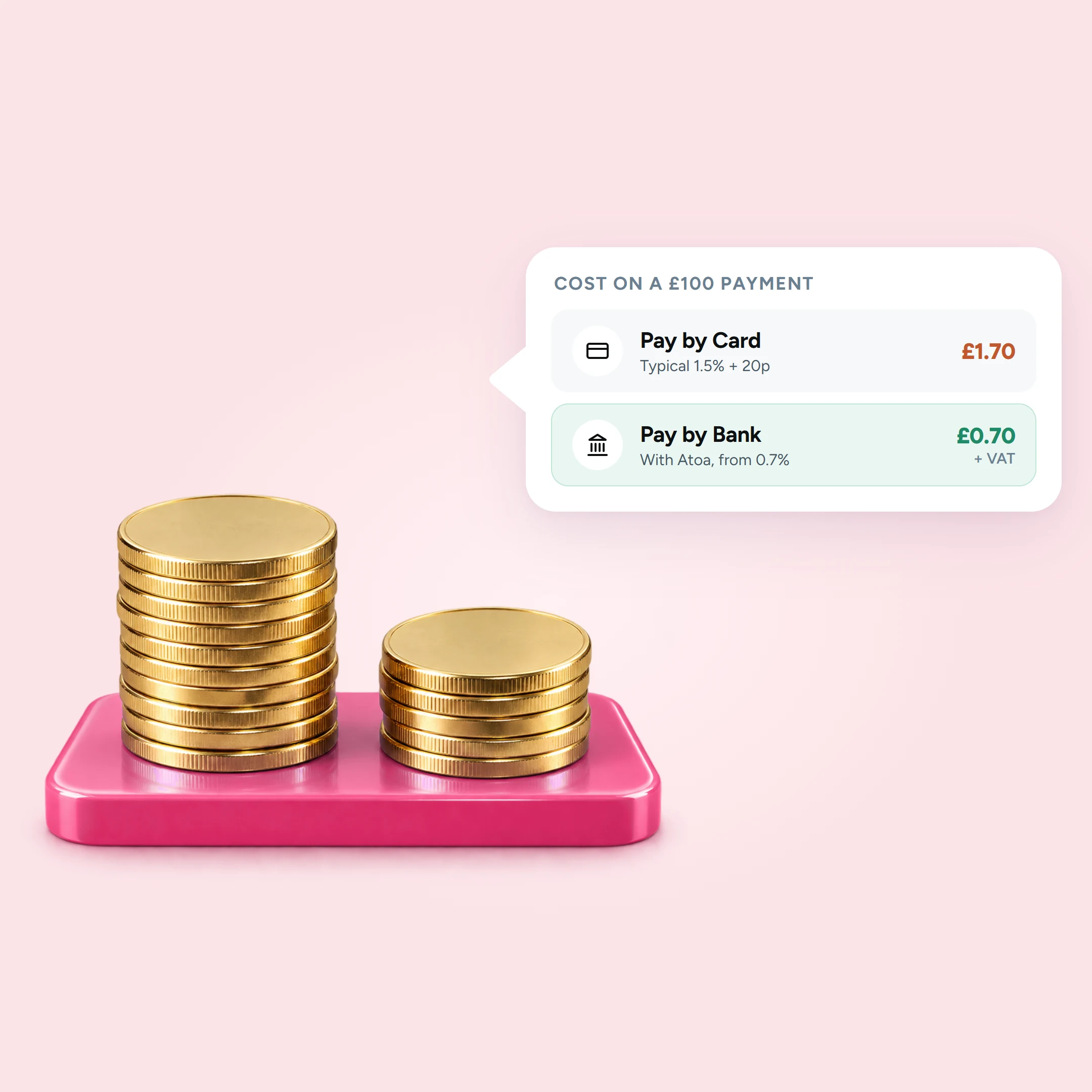
Pay by Bank allows customers to approve account-to-account payments through their banking apps. Payments typically arrive within seconds through Faster Payments. Atoa charges 0.7% plus VAT for this service.
Card payments support Visa, Mastercard and American Express, along with Apple Pay and Google Pay. Card-payment services are provided by Rapyd Payments Limited. Businesses can accept payments in person, online and through payment links.
Card chargebacks belong to the card-scheme process. Pay by Bank uses bank-payment rails, so card chargeback rules do not apply. Customers and businesses still retain rights under their contract and applicable law. Refunds, complaints, fraud reviews and reimbursement rules may still be relevant.
Atoa Payments Limited is authorised by the Financial Conduct Authority under the Payment Services Regulations 2017 as an Authorised Payment Institution to provide account information services and payment initiation services (FRN 1007647). Card payment services are provided by Rapyd Payments Limited, which is authorised by the FCA (FRN 900688).
Conclusion
A merchant of record becomes the legal seller and takes on defined responsibilities for the sale. That arrangement can help businesses managing tax and compliance across several countries.
Most UK businesses selling directly to UK customers already hold this role themselves. They generally need acquiring and payment acceptance rather than another company becoming the seller.
Before choosing an MoR, compare its full cost with the work and risk it would remove. Also check who owns the customer contract, data and checkout experience.
Frequently Asked Questions
What is a merchant of record?
A merchant of record is the legal seller in a customer transaction. It handles the responsibilities attached to the sale, including tax, refunds, card chargebacks and consumer compliance.
Am I the merchant of record for my own sales?
Usually, yes. A business selling under its own name normally acts as the merchant of record. A marketplace or specialist provider takes the role only when the commercial agreement places it between the business and customer.
What is the difference between an MoR and an acquirer?
An MoR is the legal seller and owns the customer transaction. An acquirer enables card acceptance and settles card proceeds while the merchant remains the seller.
Is a payment facilitator the same as a merchant of record?
No. A payment facilitator usually onboards a business as a sub-merchant. The business generally continues selling to its own customers. An MoR becomes the seller for the covered transaction.
Who pays VAT when a marketplace acts as the seller?
The marketplace may account for VAT when the UK deemed-supplier rules apply. The underlying seller can still retain other tax or customs duties. The correct treatment depends on the transaction.
Do I need an MoR to sell online in the UK?
Most UK businesses selling under their own name already act as their own merchant of record. They need a suitable way to accept payments and meet their existing business obligations.
Is Atoa a merchant of record?
No. Atoa provides Pay by Bank and card-payment services. The business accepting payment remains the legal seller and keeps the customer relationship.
Sources
- VAT rules for online marketplaces and place of supply: GOV.UK, VAT and online marketplaces; HMRC.
- UK card-acquiring costs: Payment Systems Regulator, card-acquiring market review.
- Payment institution authorisation: Financial Conduct Authority.
- UK payment market data: UK Finance, UK Payment Markets.
SHARE ARTICLE
Share link copied!