
Ready to get started?
Easily integrate next-generation payments and financial data into any app. Build powerful products your customers love.
SHARE ARTICLE


 Share link copied!
A chargeback happens when a customer disputes a card payment through their bank. The payment may be reversed, leaving your business with fees and paperwork. Repeated disputes can also bring closer scrutiny from your payment provider.
Understanding how to prevent chargebacks starts with understanding their causes. A missing delivery needs a different response from an unauthorised purchase. An unfamiliar statement entry might simply need a clearer business name.
Visa’s Acquirer Monitoring Programme, known as VAMP, adds another consideration. It measures fraud reports alongside disputes, so chargebacks show only part of the picture.
This guide explains the 2026 VAMP rules and how the ratio works. It also covers practical prevention steps, dispute evidence and where Pay by Bank fits.
What is the Difference Between A Chargeback and A Refund?
A refund is a repayment your business issues to a customer. A chargeback follows a dispute raised through the customer’s card issuer.
The payment provider sends you the dispute details and response deadline. You can accept the claim or challenge it with relevant evidence. Your agreement determines how disputed funds and fees affect your account.
An approved payment can still become a chargeback later. Authorisation confirms that the issuer allowed the payment to proceed. Proof of delivery and fulfilment are separate matters.
Chargebacks also differ from Section 75 protection. Chargebacks follow card-scheme rules, while Section 75 provides legal rights for qualifying credit purchases. MoneyHelper shares how these protections differ.
What Are the 2026 VAMP Rules?
VAMP is Visa’s programme for monitoring fraud, disputes and enumeration activity. Enumeration involves testing payment credentials to identify usable card details.
The consolidated programme’s published changes took effect in June 2025. From 1 April 2026, Europe’s excessive merchant ratio threshold became 1.5%.
Merchant identification also depends on other conditions, including the acquirer’s monitoring position. Visa specifies a monthly minimum of 1,500 counted fraud reports and disputes for Europe.
These are monitoring thresholds rather than targets for an acceptable business performance. Your provider may apply its own risk limits.
How is the VAMP Ratio Calculated?
VAMP measures a ratio built like this: the number of fraud reports (TC40) plus the number of disputes (TC15), divided by the number of settled card-not-present transactions over the period. The key word is card. The denominator counts card transactions only.
VAMP ratio = counted fraud reports and disputes ÷ settled Visa card-not-present transactions × 100
The calculation uses transaction counts rather than payment values. Its source records include fraud reports (TC40), disputes (TC15) and settled transactions (TC05).
Certain pre-dispute resolutions and qualifying Compelling Evidence 3.0 fraud reports can be excluded. Timing affects their treatment, so use your acquirer’s confirmed figures.
Take a look at this example. Suppose your business processes 100,000 qualifying transactions during a month. After applicable exclusions, the combined event count is 1,000.
1,000 ÷ 100,000 × 100 = 1%
Now suppose qualifying transactions fall to 80,000, while counted events remain unchanged.
1,000 ÷ 80,000 × 100 = 1.25%
| Measure | Original month | Lower card transaction volume |
|---|---|---|
| Qualifying settled transactions | 100,000 | 80,000 |
| Counted fraud reports and disputes | 1,000 | 1,000 |
| Calculated ratio | 1% | 1.25% |
The ratio rises because the same events sit against fewer transactions. This can happen when customers move to another payment method.
If events fall proportionately with transactions, the ratio stays unchanged. If events fall faster, the ratio improves.
These figures illustrate the calculation rather than predict customer behaviour. They also reveal nothing about the monetary value of losses. Review the ratio, event count and financial losses separately.
Why Do Customers Raise Chargebacks?
Chargebacks can result from fraud, service problems or simple misunderstandings. Common reasons include:
- A payment made using stolen card details.
- Goods arriving late, damaged or different from their description.
- A subscription payment taken after cancellation.
- Duplicate billing or an outstanding refund.
- An unfamiliar business name appearing on a statement.
Your own dispute records show which issues need attention. Group cases by reason, sales channel and location to identify patterns.
What is Friendly Fraud?
Friendly fraud describes a customer disputing a genuine purchase as unauthorised. It can involve mistaken recognition or deliberate misuse.
For example, a customer might recognise your shop but overlook its registered company name. An unfamiliar statement entry could then prompt a dispute.
Deliberate misuse involves knowingly disputing a genuine purchase to recover the money. Your response should follow the evidence rather than assumptions about intent.
Genuine complaints about delivery or product quality need separate consideration. Treating every dispute as friendly fraud can leave service problems unresolved.
How To Prevent Chargebacks in Everyday Operations
Chargeback prevention works best when it addresses the problems your customers actually encounter. Review recent disputes before deciding where to make changes.
1. Use a recognisable name on statements
The billing descriptor is the business name shown on a customer’s statement. Use the trading name customers recognise, within your provider’s available settings.
If your statement name differs from your brand, explain this at checkout. Repeat that explanation in receipts and order confirmations.
Include accessible contact details so customers can query unfamiliar payments directly. Your team should be able to locate the order quickly.
2. Explain what customers are buying
Clear product information helps customers understand what to expect before payment. Include delivery estimates, relevant specifications and cancellation terms.
For services, confirm the agreed work, appointment date and deposit conditions. For subscriptions, explain billing frequency and provide accessible cancellation instructions.
Keep the version of the terms accepted with each order. This provides a useful record if your policies change later.
3. Keep delivery and refund updates clear
Customers need updates when an order takes longer than expected. Explain the delay and offer the options available to them.
When a refund is due, process it promptly and send confirmation. Distinguish your handling time from the bank’s processing time.
A customer awaiting a refund should know its status and expected timing. This gives them useful information if the credit takes longer to appear.
If a chargeback has already arrived, coordinate further refunds with your provider. That helps avoid repaying the purchase through two separate processes.
4. Use authentication alongside other checks
3D Secure helps issuers authenticate customers during online card payments. Eligible transactions may receive a liability shift for certain fraud disputes.
The protection depends on the transaction and applicable scheme rules. Visa explains how 3D Secure supports authentication and fraud prevention.
Claims about delivery, cancellations or product quality require different controls. Review unusual purchase patterns with your provider and choose checks appropriate to your business.
5. Keep evidence with each order
Useful records show what the customer purchased, agreed and received. Depending on your business, these could include delivery tracking or signed job sheets. Digital services may rely on relevant access and usage records.
Keep customer messages, cancellation requests and refund confirmations with the transaction. Records are easier to review when they follow a clear timeline.
Store only necessary information, with appropriate retention and access controls. Retain permitted verification results rather than the card’s security code. PCI DSS prohibits storing CVV codes after authorisation, including encrypted copies.
6. Give someone responsibility for dispute deadlines
Assign someone to monitor dispute notifications and arrange cover during absences. Record the response deadline as soon as each case arrives.
The response should address the specific claim with relevant evidence. Review the outcome afterwards and use it to improve your processes.
What Do Chargeback Reason Codes Tell You?
Chargeback reason codes identify why a card payment is being disputed. They help your team select the records needed for a response.
These examples use Visa’s categories. Other card schemes use their own codes and requirements.
| Visa code | Dispute concerns | Records to review |
|---|---|---|
| 10.4 | Alleged fraud in a card-absent transaction | Authentication results and eligible purchase-history evidence |
| 13.1 | Allegedly missing goods or services | Delivery confirmation, collection records or proof of completed work |
| 13.2 | A recurring payment taken after cancellation | Cancellation dates, billing history and customer correspondence |
| 13.3 | Allegedly defective goods or differences from the description | Original description, relevant photographs and correspondence |
| 13.7 | Cancelled goods or services | Cancellation records, applicable terms and refund evidence |
These records support your response rather than guarantee a successful challenge. Follow your provider’s instructions for the specific dispute. The Visa dispute management guidelines explain its categories and response requirements.
How Should You Respond To a Chargeback?
Check the transaction, reason code and deadline before preparing your response. Then compare the customer’s claim with your records.
Where the claim is valid, follow your provider’s process for accepting it. Where evidence supports a challenge, submit the relevant documents with a clear explanation. This process is often called representment.
For example, a delivery dispute needs evidence connecting delivery to that order. A receipt establishes payment, while delivery records address whether the goods arrived.
Keep the financial result separate from the monitoring result. Recovering disputed funds and changing a scheme’s recorded events are different outcomes.
1. Visa Compelling Evidence 3.0
Compelling Evidence 3.0, or CE3.0, helps address eligible Visa 10.4 fraud disputes. It uses qualifying earlier purchases to establish a customer’s transaction history.
Visa’s guidance describes two earlier transactions, generally 120 to 365 days before the dispute. They must meet conditions concerning fraud history and matching data.
At least two qualifying data elements must match across the transactions. One must be an IP address or device identifier.
CE3.0 can operate before or after a dispute, depending on the setup. Confirm eligibility and submission requirements with your acquirer. Visa’s merchant guidance explains the criteria.
2. Mastercard First-Party Trust
Mastercard First-Party Trust uses additional transaction information to help identify genuine purchases. Participating businesses can share qualifying device, delivery and identity information.
Check availability and evidence requirements with your payment provider. Access depends on the provider and applicable programme rules.
Where Does Pay by Bank Fit?
Pay by Bank lets customers approve payments through their banking app. Funds move between bank accounts rather than through a card network. These payments therefore operate outside card-scheme chargebacks.
That distinction applies to the bank payment itself. Any card transactions you continue accepting remain subject to card dispute rules.
Customer rights and refund obligations still apply to bank payments. Eligible scam payments may qualify for separate reimbursement protections. The Payment Systems Regulator explains these protections and their scope. Ordinary disagreements about purchases differ from scam claims.
How Atoa Supports Bank and Card Payments
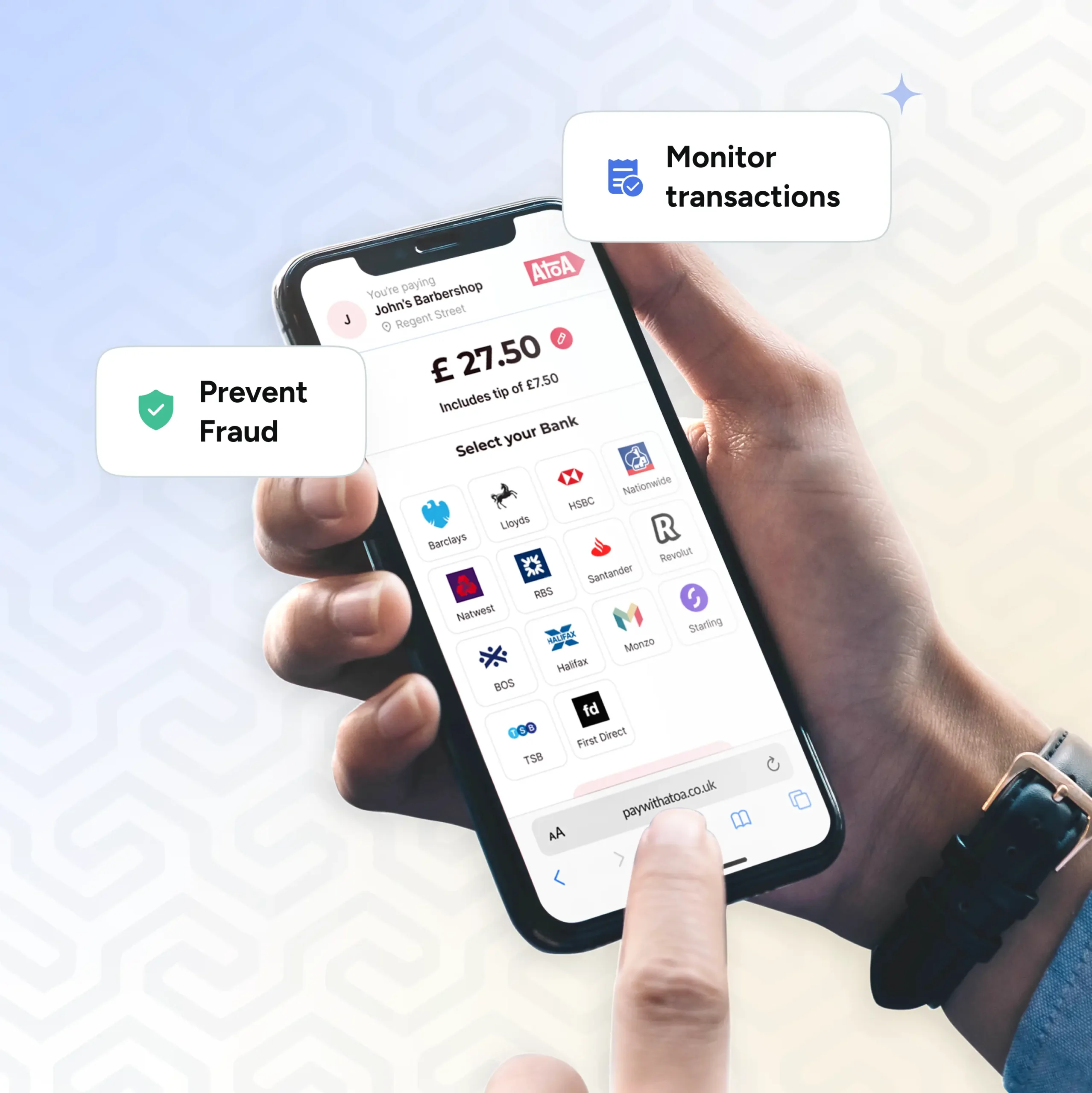
Atoa offers Pay by Bank alongside its card payment service. Businesses can offer bank payments through online checkout, payment links and QR codes.
Pay by Bank costs 0.7% plus VAT, with funds typically arriving within seconds. Card-payment pricing starts from 1.3%, with charges varying by transaction type. Online card payments carry an additional fixed fee; check the applicable payment rates.
The right payment mix depends on customer preferences and your operating needs. Continue reviewing card disputes and monitoring figures as that mix changes.
Conclusion
Understanding how to reduce chargebacks begins with your own dispute records. Clear billing, reliable delivery and responsive support address different causes. Authentication and organised evidence help with fraud prevention and dispute responses.
Under VAMP, review the monitored ratio alongside event counts and financial losses. Where you offer Pay by Bank, explain the payment method and protections clearly. Keep customer service and refund handling consistent whichever method customers choose.
Frequently asked questions
What is an acceptable chargeback rate in the UK?
The applicable limits depend on your card scheme and payment provider. Confirm which measures your provider uses and investigate increases early. A chargeback rate and a combined fraud-and-dispute ratio measure different things.
How can businesses reduce chargebacks across multiple locations?
Use consistent billing names, receipts and refund procedures across your locations. Review disputes by branch to identify recurring fulfilment or service issues. Give each team responsibility for supplying evidence before the response deadline.
Does 3D Secure stop every chargeback?
3D Secure supports authentication and may shift liability for eligible fraud disputes. Delivery, quality and cancellation claims require separate evidence and controls. Confirm the transaction’s liability position with your provider.
How do I win a chargeback dispute?
A successful challenge depends on the reason code and available evidence. Submit relevant records within your provider’s deadline and explain what they establish. The outcome depends on the facts and applicable scheme rules.
Can a refunded payment still become a chargeback?
A customer may dispute a payment while the refund is processing. Send the refund confirmation to your provider if a dispute arrives. Coordinate further action to avoid issuing a duplicate repayment.
Can customers request refunds after paying by bank?
Customers can request refunds and exercise their applicable consumer rights. Pay by Bank operates outside card chargeback schemes, with separate bank-payment protections. Your refund policy must respect the legal rights that apply.
SHARE ARTICLE
Share link copied!