
Ready to get started?
Easily integrate next-generation payments and financial data into any app. Build powerful products your customers love.
SHARE ARTICLE


 Share link copied!
Look closely at a card statement and the fees are rarely simple: a headline rate, then interchange, scheme fees and the odd surcharge on top. So when businesses hear that open banking payments are “cheaper,” the fair question is: cheaper by how much, and where’s the catch? This guide answers it properly, what open banking payments actually cost, the pricing models providers use, the hidden fees to watch, and how it all stacks up against cards.
What are open banking payments?
Open banking payments, also called Pay by Bank or account-to-account (A2A) payments, let a customer pay a business straight from their bank account. Instead of entering card details, they approve the payment in their own Bank app with Face ID, fingerprint or a passcode, and the money moves over the UK’s Faster Payments network in seconds. It runs on secure, FCA-regulated open banking rails and skips the card networks entirely — part of why it is transforming how UK businesses get paid. Adoption is climbing fast: analysts project the open banking market to grow at more than 27% a year to 2030 (Grand View Research), and you can see the UK picture in our open banking adoption insights.
That skip past the card networks is the whole cost story. Card payments carry interchange and scheme fees set by Visa and Mastercard. Open banking has neither, which is why the economics look so different.
How much do open banking payments cost?
For your customers, open banking payments are completely free. Under the UK’s open banking framework, overseen by the Financial Conduct Authority (FCA) they can approve a payment or share bank data at no charge, so there’s never a surcharge when they use Pay by Bank at checkout.
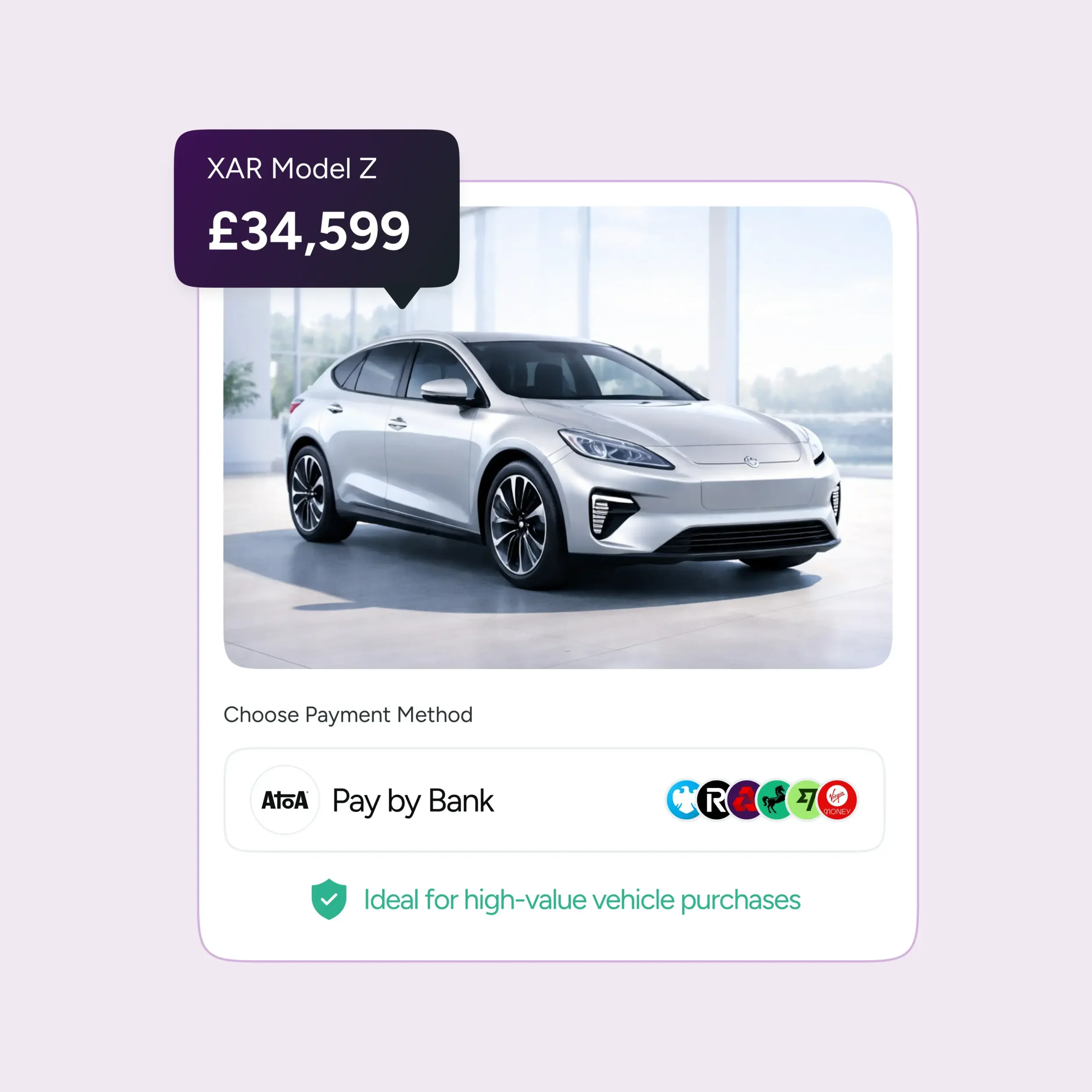
For your business, they aren’t free, but they are low-cost. You pay your provider a small fee per transaction to cover the bank connections, compliance, fraud checks and settlement they run for you. Because there’s no interchange or scheme mark-up to pass on, that fee sits far below card costs. With Atoa, Pay by Bank starts from 0.7% + VAT, against card fees from 1.3% — up to 50% lower on your payment costs.
Open banking pricing models explained
Providers price it in a few ways, and knowing which you’re on makes quotes easy to compare:
- Percentage per transaction: a set percentage of each payment, sometimes with a small fixed amount added. The most common and most predictable as volumes grow.
- Per successful payment: you’re charged only when a payment completes, so failed or abandoned attempts cost nothing.
- Flat fee per transaction: a fixed pence amount whatever the payment size, which can suit high-value baskets.
- Tiered or monthly plans: a monthly platform fee blended with a lower per-transaction rate, aimed at higher-volume merchants.
There’s no single right model. A business taking many small payments usually wants a low percentage; one taking a few large invoices may prefer a flat fee or a cap, and our comparison of open banking payment providers works both cases through with each provider’s published prices. You can see how Atoa keeps it simple on our pricing page.
Hidden costs to watch for
The headline rate is rarely the full picture. Before you sign, check for:
- Setup or integration fees to connect your website, till or accounting tool.
- Monthly minimums or platform charges that apply even in a quiet month.
- Failed-payment or refund fees.
- Contracts, lock-ins or notice periods.
Atoa keeps this simple: transparent pricing, no contract and no machine rental, so the rate you see is the rate you pay.
Open banking vs card fees
The clearest way to judge the value is side by side. (For the full comparison, see our guide on open banking payments vs card payments.)
| Cost | Open banking (Pay by Bank) | Cards |
|---|---|---|
| Interchange fee | None | Yes |
| Scheme fees | None | Yes |
| Typical rate | From 0.7% + VAT (Atoa) | From 1.3% + ~20p |
| Chargebacks | None (approved in the bank app) | Possible |
| Settlement | Seconds | Often 1–3 working days |
Even after a provider’s fee, open banking usually lands comfortably under the cost of cards which is why fee-conscious businesses keep moving more of their volume across. If you want the short version, we cover it in is Pay by Bank cheaper than cards?
What about recurring payments?
For subscriptions, memberships or regular invoices, open banking also underpins Variable Recurring Payments (VRP): a mandate the customer approves once, then you collect against it. It’s the open banking answer to card-on-file and Direct Debit, with the same low-cost, no-chargeback economics.
Why businesses switch, even with a fee
A small per-transaction fee still buys a lot:
- Lower costs than cards, with no interchange, scheme fees or chargebacks.
- Instant settlement, so money lands in seconds rather than days.
- Stronger security, because every payment is approved inside the customer’s own Bank app and no card details are shared.
- Simpler reconciliation, with payments matched automatically to invoices in tools like Xero and QuickBooks.
With Atoa, these come as standard, alongside partial payments, payment links and full accounting integration — so the fee saving is only part of the value.
The takeaway
Open banking payments are free for your customers and low-cost for your business. The real value isn’t that they’re “free,” but that they’re fair: transparent, predictable pricing with no card-network mark-up, settlement in seconds and no chargebacks. It’s a big part of the future of payments in an open banking world and, for most UK businesses, a materially lower cost of getting paid.
FAQ
How much do open banking payments cost?
They’re free for customers and low-cost for businesses. With no interchange or scheme fees, providers charge a small percentage or flat fee per transaction with Atoa, Pay by Bank starts from 0.7% + VAT.
Are open banking payments cheaper than cards?
Usually, yes. Skipping the card networks removes interchange and scheme fees, so Atoa’s Pay by Bank starts from 0.7% + VAT — up to 50% lower than typical card fees.
What pricing models do open banking providers use?
Most charge a percentage per transaction. Others charge per successful payment, a flat fee per transaction, or a tiered/monthly plan. The best fit depends on your volume and average transaction value.
What hidden fees should I watch for?
Setup or integration fees, monthly minimums, failed-payment or refund charges, and contract lock-ins. Atoa has transparent pricing with no contract and no machine rental.
Do open banking payments have scheme fees?
No. Open banking is account-to-account, so there are no card interchange or scheme fees — a big reason it costs less than cards.
Are open banking payments free for customers?
Yes. Customers are never charged to approve an open banking payment or to share bank data under the UK’s open banking framework.
Sources
- Open Banking Limited — what open banking is and how payments are regulated: Open Banking
- Financial Conduct Authority — open banking and payment services regulation: FCA
- UK Faster Payments (Pay.UK) — the rails behind account-to-account settlement: Pay.UK
- Grand View Research — open banking market size and growth: Grand View Research
SHARE ARTICLE
Share link copied!