Ready to get started?
Easily integrate next-generation payments and financial data into any app. Build powerful products your customers love.
SHARE ARTICLE


 Share link copied!
Private healthcare in the UK is no longer confined to a clinic room. Physiotherapists do home visits. Nutritionists hold consultations over video calls. Osteopaths travel to clients. Counsellors and therapists work across a mix of in-person and remote sessions. For all of these professionals, collecting payment for work done away from a reception desk requires a different kind of setup. It’s one that is flexible enough to keep up with how they actually work.
Private healthcare payment solutions in the UK have improved considerably over the past few years, and remote collection in particular is now far more straightforward than it used to be. Here is a look at what is available and how it applies to different types of private healthcare practice.
The challenge of collecting payment remotely
For practitioners working outside a fixed clinic, the traditional options were limited: ask for a bank transfer, take card details over the phone, or invoice and hope for prompt payment. All of these have drawbacks. Bank transfers require patients to manually enter details and are prone to errors or delays. Taking card details over the phone raises security concerns. Invoicing creates a lag between delivering care and receiving payment, and chasing unpaid invoices takes time that most solo or small practice practitioners do not have.
What remote healthcare professionals need is a way to request and receive payment quickly, securely, and with as little friction as possible for the patient.
Payment links: the simplest remote collection method
A payment link is a secure URL sent to a patient by SMS or email. The patient taps it, lands on a payment page, and chooses how to pay. For private healthcare professionals collecting payment after a remote consultation or home visit, this removes almost all of the friction from the process. The practitioner generates the link from their phone or dashboard, sends it as soon as the session ends, and the patient pays in a few taps while the appointment is still fresh.
According to WriteUpp’s guide to telehealth software for UK practitioners, SMS and email reminders can cut no-shows by up to 40%. For payment requests, the same principle holds: sending a link the moment a session ends keeps the transaction front of mind while the patient is still engaged.
Lower fees for remote healthcare payments
When a patient pays by card remotely, the transaction passes through card networks, each of which takes a cut. For a private healthcare professional processing payments daily, those fees add up across a full calendar.
Pay by Bank removes that layer entirely. The patient approves the payment inside their Bank app using Face ID or fingerprint, and the money moves directly to the practitioner’s account via the UK’s Faster Payments network.
Fees are significantly lower than card processing, there are no chargebacks, and settlement is instant. For remote healthcare practitioners, the cost saving across a full month of consultations is meaningful.
How different practitioners use remote payments
The flexibility of payment links and Pay by Bank makes them well suited across a range of private healthcare disciplines:
- Physiotherapists doing home visits can send a payment link immediately after the session, before leaving the patient’s home
- Nutritionists and dietitians holding video consultations can send a link at the end of the call or in a follow-up message
- Osteopaths travelling between patients can collect payment remotely without needing a card terminal on site
- Counsellors and therapists can request payment ahead of a session. This is to reduce no-shows, or collect immediately after without any awkward in-room transaction
- Private GPs and specialists offering remote consultations can send a payment request alongside appointment confirmation
Deposits for remote appointments
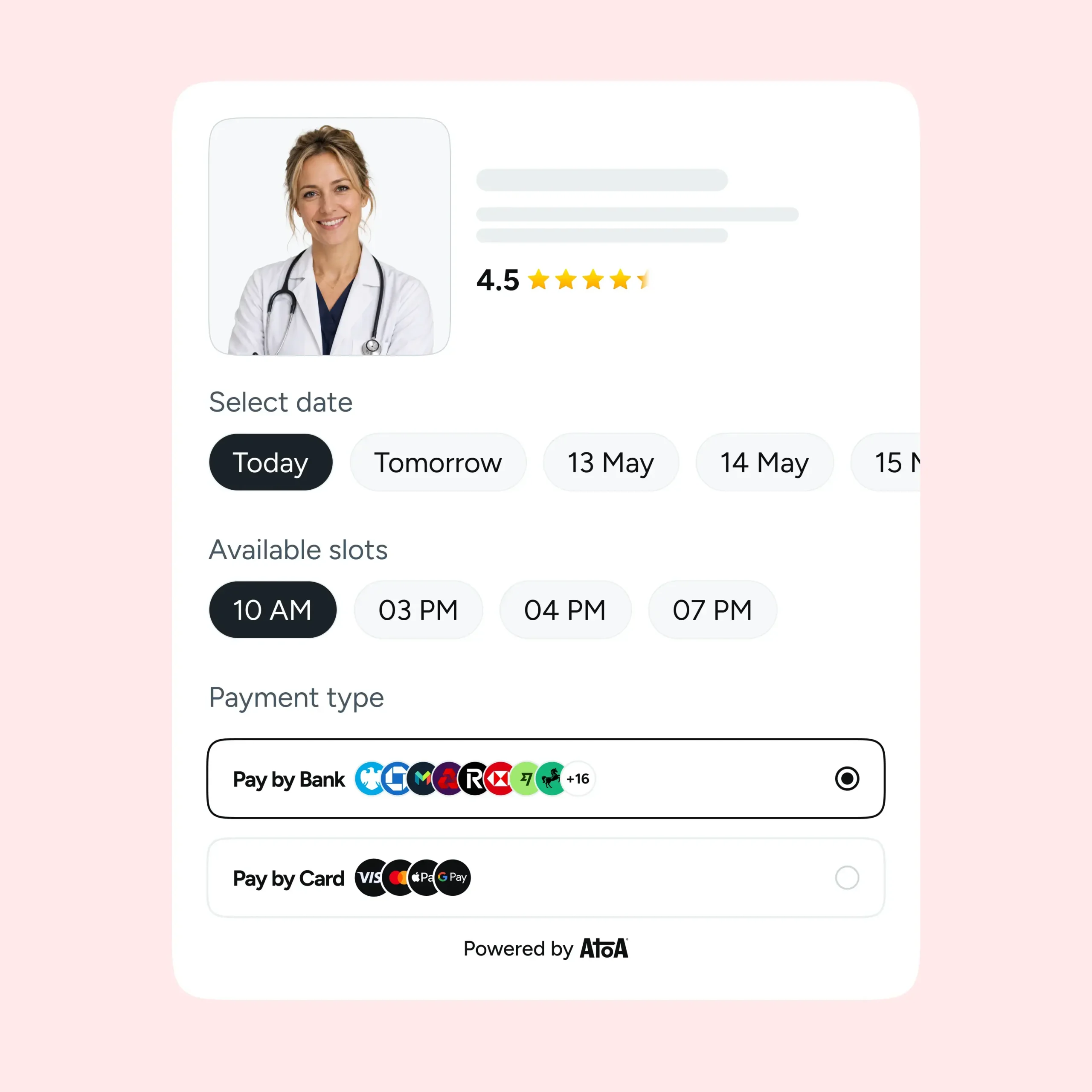
One of the more practical uses of remote payment links is collecting a deposit at the time of booking. A patient who has paid upfront is significantly less likely to miss the appointment or cancel without notice. This applies as much to remote consultations as it does to in-person sessions. Also, for practitioners whose income depends on a full calendar, reducing that exposure is worth the small step of sending a link at booking.
Getting paid should be the easy part
For private healthcare professionals, clinical work is the priority. Payment collection should be the easy part. It should be quick to set up, straightforward for patients, and reliable enough. Platforms like Atoa are built with exactly that in mind. It brings Pay by Bank and card payments together for UK practitioners who need flexibility without the overhead. The right setup means less time chasing, faster access to funds, and one fewer thing to think about between appointments.
Frequently asked Questions
What are the best remote payment options for healthcare practitioners?
The best remote payment options for healthcare practitioners are payment links and Pay by Bank, which let you request and collect payment from a phone after a home visit or video consultation. The patient taps a link and pays in seconds, with lower fees and no chargebacks on Pay by Bank. Atoa brings Pay by Bank and card payments together for UK practitioners.
How do payment links work for private clinics?
Payment links work by sending the patient a secure URL by SMS or email, which they open to choose how to pay and complete the payment themselves. The practitioner generates the link from a phone or dashboard and sees confirmation once it is paid. With Atoa, patients can pay by card or Pay by Bank from the same link.
Can practitioners take deposits to reduce no-shows?
Yes, practitioners can take deposits at the time of booking by sending a payment link, which makes patients less likely to miss or cancel an appointment. A patient who has paid upfront has more reason to attend. Atoa lets you request deposits by link for both in-person and remote appointments.
Is Pay by Bank safe for patient payments?
Yes, Pay by Bank is safe for patient payments because each one is approved in the patient’s own banking app using Face ID or fingerprint. The money moves directly to the practitioner’s account via Faster Payments, with no card details shared. Atoa is FCA authorised (FRN 1007647) and certified to ISO 27001 and SOC 2.
Are there chargebacks with Pay by Bank?
No, there are no chargebacks with Pay by Bank because the patient authenticates and authorises the payment directly in their banking app. The account-to-account transfer carries verifiable consent, so it cannot be reversed through a card dispute. This gives healthcare practitioners more certainty over the fees they collect.
SHARE ARTICLE
Share link copied!