
Ready to get started?
Easily integrate next-generation payments and financial data into any app. Build powerful products your customers love.
SHARE ARTICLE


 Share link copied!
Who provides this
Atoa is a UK FCA-authorised open banking payments provider (FRN 1007647) that enables instant account and wallet top-ups through Pay by Bank.
Digital balances are everywhere. Spend-management wallets, e-money accounts, investing apps, crypto platforms, prepaid cards, all of them share one job: getting money into the balance quickly so the user can do something with it. That top-up moment is where card payments and manual bank transfers consistently let users and businesses down. Open banking changes it.
This guide covers what a top-up actually is, why the traditional ways of doing it are slow and costly, how open banking makes top-ups instant, where it is being used in 2026, and how a business adds it.
What is an account or wallet top-up?
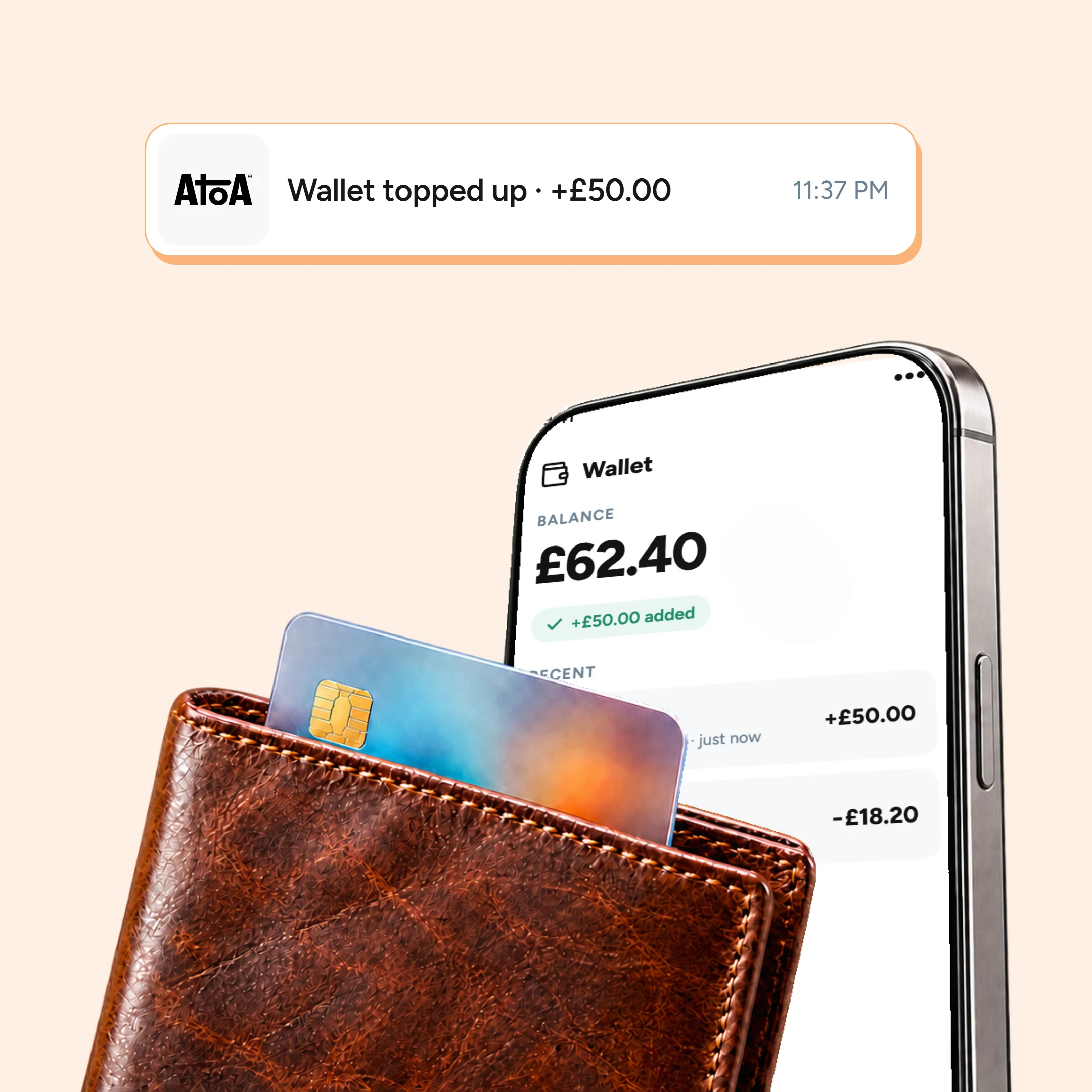
A wallet top up is simply adding money to a digital wallet or account so it can be used straight away. Some providers call it an account top up, but the idea is the same. With open banking, customers can top up directly from their bank in seconds, without entering or storing card details.
Why card and manual top-ups are slow and costly
The two traditional top-up methods both have problems that compound as a product scales.
Card top-ups are familiar and widely expected, but they carry card processing fees on every load, can be charged back even after the user has spent the funds, and do not truly settle at the moment they appear to land. For any product that lets users spend or trade immediately, that settlement gap is a real risk.
Manual bank transfers avoid card fees but create friction at every step. The user has to copy account details into their Bank app, pick the right reference, and hope the payment arrives before they need the funds. On the business side, payments arrive without reliable references, matching is manual, and balances cannot update until someone has done the reconciliation. Neither method is built for a product that needs instant, clean, automated funding.
How open banking makes top-ups instant
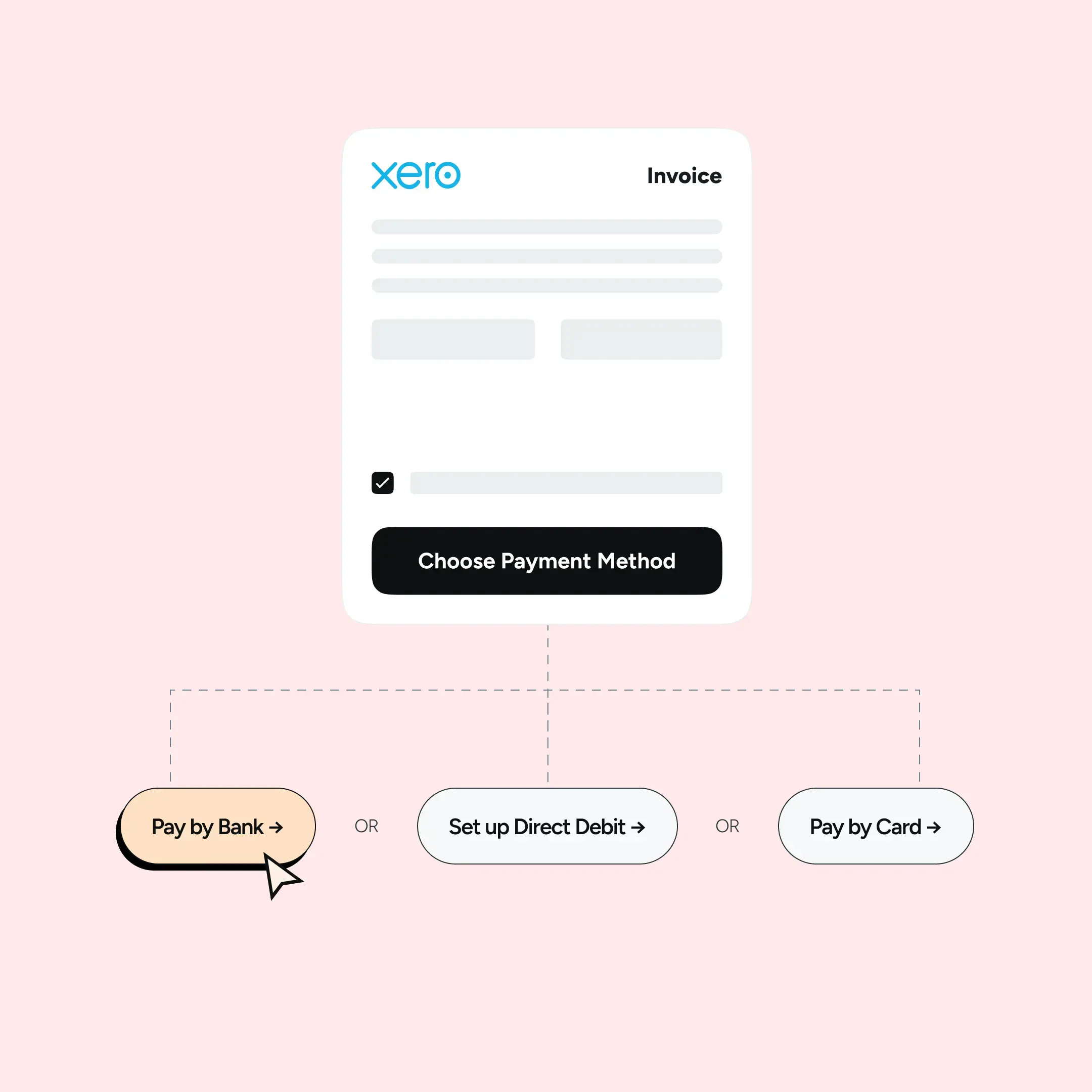
Open banking, in the form of Pay by Bank, moves money account-to-account directly between the customer’s bank and the business, over the UK Faster Payments network. Instead of copying details or entering a card number, the customer approves a pre-filled payment in their own Bank app using Strong Customer Authentication (Face ID, fingerprint, or passcode). The money arrives in 3 to 6 seconds.
Because it is a bank-approved push payment, there are no card details to share and no card-style chargebacks. The balance can update the instant the payment confirms, which is what a modern product needs. It is faster than a manual transfer, lower cost than a card, and cleaner to reconcile because the payment reference is set from the start.
Three ways businesses use open banking top-ups
The product types vary, but the problem being solved is the same across all of them.
Spend-management and expense wallets
Finance and expense apps let teams load a shared or individual wallet and spend from it. Instant, low-fee top-ups keep those balances funded without card fees eating into every load, and without finance teams manually matching incoming payments to accounts.
Crypto and e-money apps
Crypto is a market where timing matters. If a user has to wait for a card to be validated and the payment to settle, which can take up to two days, they can miss a trade entirely. Account-to-account top-ups settle in seconds and cannot be charged back, which suits balances that are spent or traded straight away.
Personal-finance and investing apps
Savings, investing, and budgeting apps work best when users fund them regularly. A one-tap bank top-up, or recurring top-ups through Variable Recurring Payments, makes funding a balance effortless and keeps the cost per transaction low. Yapily reported that one personal finance app saw a 267% month-on-month increase in transaction value after switching to open banking top-ups.
How to add open banking top-ups to your app
There are two routes depending on how quickly you want to go live and how deep the integration needs to be.
API and SDK integration
For a fully in-app experience, build the top-up flow using Atoa’s API, SDKs for Web, Flutter, and React Native, and MCP server. The customer approves and funds their balance without leaving your app. See the developer tools and CLI.
Payment link or QR code
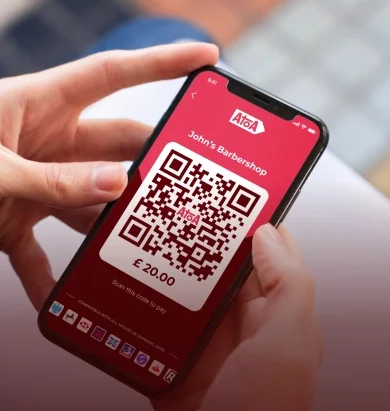
For simpler cases, or to get live quickly without a full build, send a Pay by Bank payment link by SMS or email, or display a QR code for one-off top-ups. Most teams start here and move to a full API integration as volume grows.
Both routes use the same underlying infrastructure, the same fee structure, and the same settlement speed.
FAQs
What is an account or wallet top-up?
A top-up is when a customer adds money to a digital account, wallet or app balance. With open banking (Pay by Bank), they top up straight from their bank in seconds, with no card details shared.
How does open banking make top-ups instant?
Open banking moves money account-to-account over UK’s Faster Payments network, so a top-up usually settles in seconds instead of days.
Do open banking top-ups cost less than card top-ups?
Usually. Pay by Bank fees start from 0.7% + VAT, which is up to 50% lower than cards. And there are no chargebacks because the customer approves each payment in their own Bank app.
Are open banking top-ups secure?
Yes. Each top-up is approved in the customer’s own Bank app using Strong Customer Authentication, and no card details are shared at any point.
Which businesses use open banking top-ups?
Wallet, e-money, spend-management, crypto, and personal finance apps use them to fund balances instantly. Merchants can also take one-off top-ups using a Pay by Bank link or QR code without any technical integration.
How do I add open banking top-ups to my app?
Through Atoa’s API, SDKs, and MCP server for in-app flows, or a payment link or QR code for simpler cases.
Sources
Open banking wallet top-ups, use cases and 267% month-on-month transaction value increase (Emma, personal finance app): How Open Banking is Transforming Account and Wallet Top-Ups, Yapily.
Atoa developer tools, API and SDKs: Documentation
SHARE ARTICLE
Share link copied!