
Ready to get started?
Easily integrate next-generation payments and financial data into any app. Build powerful products your customers love.
SHARE ARTICLE


 Share link copied!
Legal work is meticulous by nature. Contracts are drafted carefully, advice is considered, and deadlines are tracked to the day. And yet, when it comes to collecting payment, many law firms still rely on methods that would feel entirely at home in 1995. A bill goes out by post. The client sends a cheque. Someone at the firm manually logs it when it arrives, if it arrives.
The gap between how law firms do their legal work and how they collect money has grown wide enough to cost firms real revenue. According to the Law Society, firms using online payments collect 50% of their bills within seven days of issuing them. Those that do not take twice as long. That is a meaningful difference in cash flow for any practice, regardless of size.
Modern law firm payment solutions fix this, and they do not require firms to overhaul their processes to do it.
The three payment moments that matter most
Legal billing tends to happen in three distinct ways: the initial retainer, interim invoices throughout a matter, and the final bill on completion. Each has slightly different dynamics, and a good payment setup handles all three without friction.
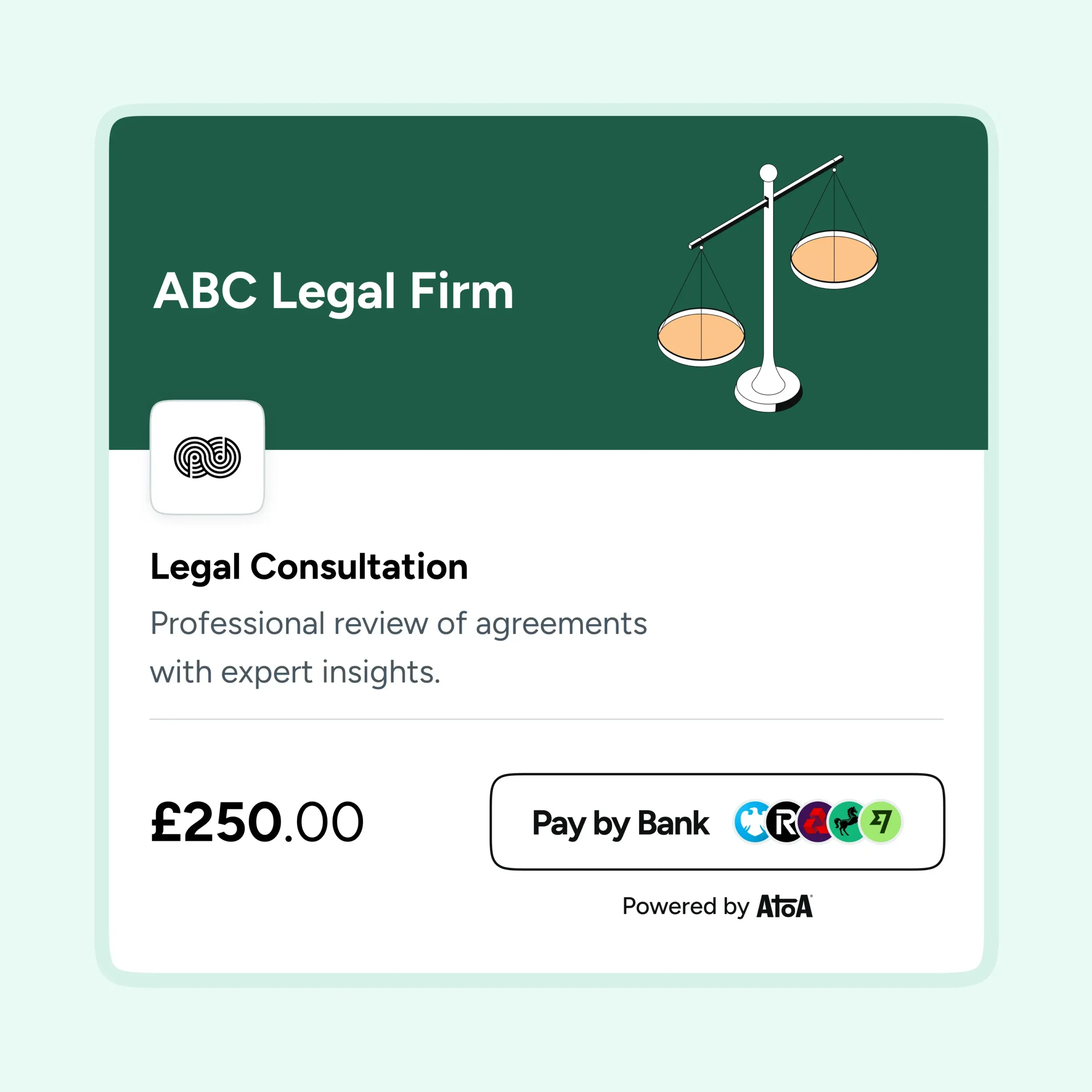
Retainer collection is where payment links are particularly useful. Rather than chasing a client to come into the office or call back with card details, a fee earner can send a secure payment link by SMS or email. The client taps the link, pays by card or directly from their bank app through Pay by Bank, and the retainer is collected before work begins. It is clean, professional, and removes the awkward follow-up call.
Interim invoices on longer matters can be some of the hardest to collect. Clients lose track of them, deprioritise them, or simply forget. Embedding a payment link directly into a digital invoice removes most of these barriers. The client receives the invoice, sees the pay button, and completes the transaction in under a minute. There is no need to find a cheque book, log in to online banking manually, or make a phone call.
Final billing often involves larger sums, particularly in conveyancing, litigation, and corporate work. This is where Pay by Bank through Atoa becomes especially relevant. Because Pay by Bank moves money directly between bank accounts through the Faster Payments network, it is well suited to higher-value transactions. There are no card processing fees eating into revenue on large invoices, no chargebacks to manage, and the money arrives in the firm’s account quickly with confirmation in real time.
What Pay by Bank looks like in practice
Atoa’s payment links support both card and Pay by Bank from the same link. A client clicks through, chooses how they want to pay, and authenticates either by card or through their bank app using Face ID or a fingerprint. The firm receives instant confirmation and reconciliation happens automatically, with no manual matching of bank statements to invoices.
For law firms that issue high volumes of invoices or handle large transactions regularly, this is one of the more practical legal payment processing upgrades available. It requires no change to existing practice management software and no complex integration.
Compliance and client accounts
Any payment solution used by a UK law firm needs to work within the SRA Accounts Rules, which govern how client money is handled, where it is held, and how it is reconciled. Atoa’s payment links direct funds to whichever account the firm specifies. So, payments can be routed to an office account or client account as appropriate to the matter. This gives fee earners and accounts teams the control they need to stay compliant without creating additional admin.
A practical first step
For most law firms, the simplest starting point is enabling payment links on invoices. It requires no hardware, no lengthy onboarding process, and no disruption to how fee earners work. Clients get a faster, more convenient way to pay. The firm gets its money sooner.
That is what good law firm payment solutions should do: get out of the way and let the firm focus on the work.
Book a demo with the Atoa team to see how payment links work for legal invoicing and retainers.
SHARE ARTICLE
Share link copied!