
Ready to get started?
Easily integrate next-generation payments and financial data into any app. Build powerful products your customers love.
SHARE ARTICLE


 Share link copied!
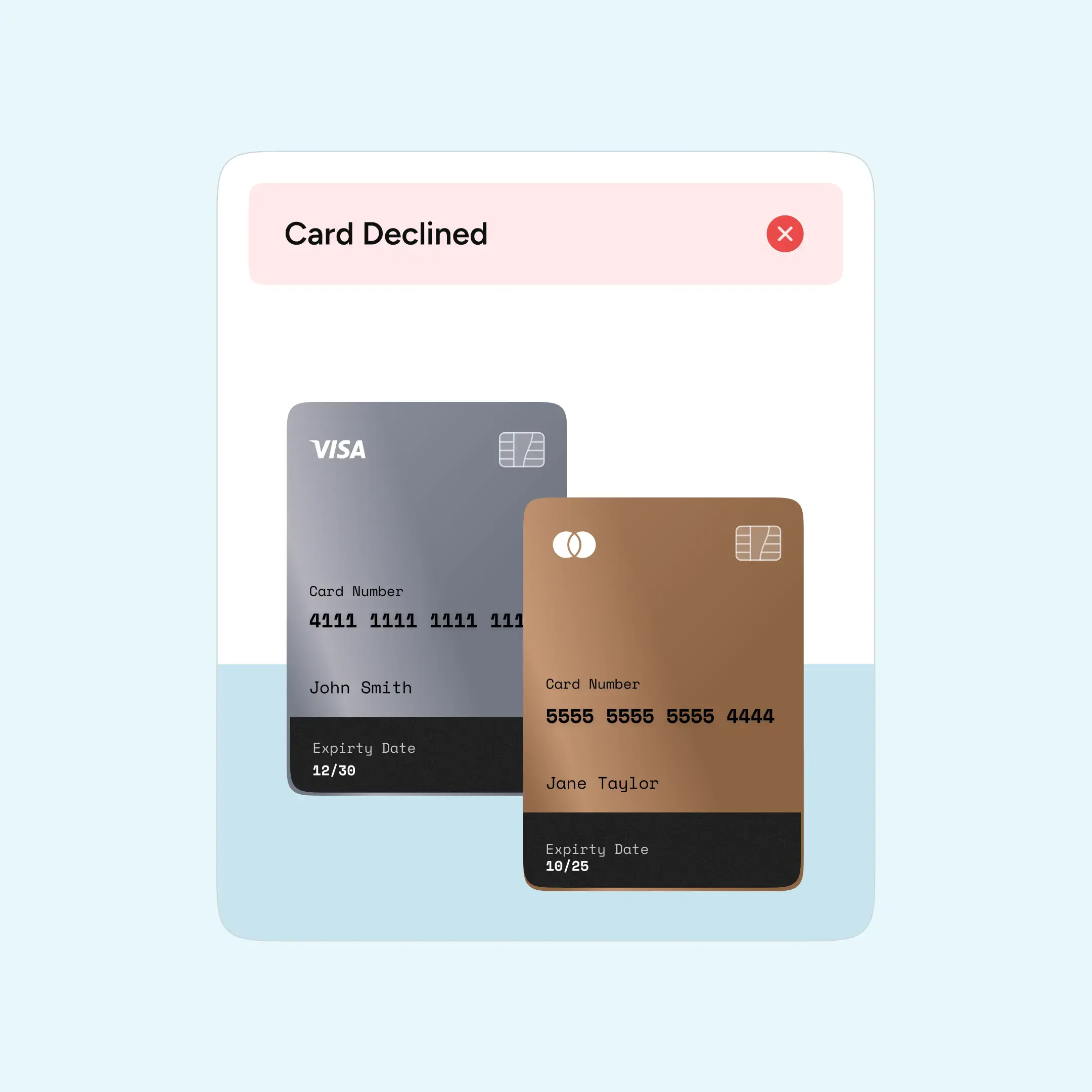
Few things are more frustrating for a customer than clicking “Pay now” and seeing their payment fail. For businesses, card declines are not just an inconvenience. They lead to lost revenue, abandoned carts, awkward follow-ups, and unnecessary admin for teams that are already stretched.
Card payments remain deeply embedded in UK commerce. According to UK Finance, UK-issued debit and credit cards were used to make 31.4 billion transactions in 2024, with a total value of just over £1 trillion. That scale highlights how heavily businesses still rely on card payments. It also means that when card payments fail, even at low decline rates, the impact across the economy is significant.
The challenge is that many of these failures are not caused by anything the business has done wrong. They are simply a side effect of how card infrastructure works.
Why card payments get declined
Card declines happen for a range of reasons, and most are outside the merchant’s control. Some of the most common causes include:
- Insufficient funds at the time of payment
- Bank security systems blocking a transaction they consider unusual
- Expired cards or outdated details stored on file
- Spending limits, especially common with debit cards
- Technical issues where payment systems fail to communicate properly between the customer’s bank, the card network, and the payment provider
Even when the customer genuinely wants to pay, these layers can introduce friction. The result is often a lost sale or a delayed payment that then needs chasing manually.
The hidden cost of relying only on cards
When cards are the main or only payment method, declines have a direct commercial impact. They also create ongoing operational noise. Customer support teams deal with “my payment didn’t work” messages. Finance teams retry collections. Sales teams lose momentum when a transaction stalls at the final step.
This becomes especially problematic for higher-value payments, where card limits and additional security checks make declines more likely.
Why Pay by Bank helps reduce declines
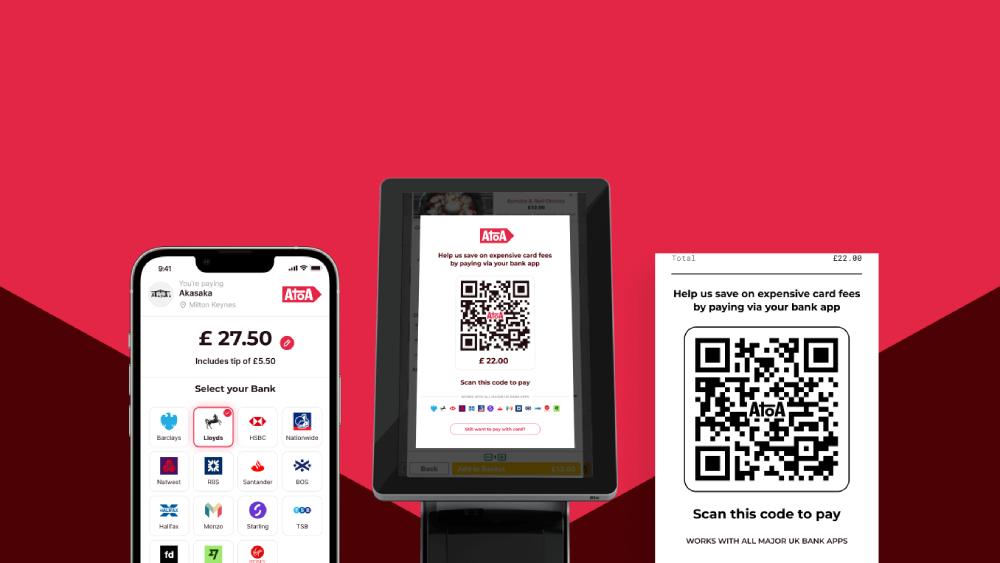
Pay by Bank works differently from cards. Instead of relying on card networks, the customer authorises the payment directly inside their own banking app. They see the payment amount and recipient clearly, then approve the transaction using their usual bank security such as a PIN, Face ID, fingerprint, or in-app confirmation.
Because the customer authenticates the payment themselves with their bank before money moves, there are fewer failure points:
- No expired card details
- No card number entry errors
- No dependency on card spending limits
- Explicit approval before the payment is processed
It is not about replacing cards entirely
Adding Pay by Bank does not mean removing card payments. In practice, the strongest payment setups offer both. Platforms such as Atoa, for example, support both Pay by Bank and Pay by Card on the same payment platform. This gives businesses flexibility and gives customers choice.
Cards remain useful for certain use cases and customer preferences. Pay by Bank often becomes the preferred option for others, particularly when:
- The payment amount is high
- The customer wants extra reassurance
- Mobile checkout speed matters
- The business wants to reduce transaction fees
Over time, many businesses find that Pay by Bank naturally becomes the main method used for larger payments, while cards remain a secondary option.
Where this matters most
Card declines and payment friction are especially costly in sectors where payments are high-value or time-sensitive, such as:
- Automotive sales and servicing
- Dental, medical, and cosmetic clinics
- Restaurants taking deposits or large group bookings
- Ecommerce businesses selling higher-ticket items
- Professional services such as plumbing, heating, electrical work, and window fitting
- Legal services and law firms collecting upfront fees
In these environments, fewer failed payments mean faster collections, fewer awkward conversations, and a smoother overall customer experience.
Final thoughts
Card declines are not a sign of poor operations but often a by-product of ageing payment infrastructure that was never designed for today’s expectations around speed and reliability. Businesses that rely solely on cards tend to accept this friction as unavoidable.
Businesses that introduce modern alternatives reduce it. Offering Pay by Bank alongside cards gives customers more choice, improves payment success rates, and can significantly reduce costs on higher-value transactions. It also creates a calmer operational environment, with fewer failed payments to chase and fewer support issues to resolve.
Book a demo with the Atoa team to see how Pay by Bank can work alongside your existing payment methods and help you reduce declines with a reliable UK payment provider.
FAQs
Are card declines the merchant’s fault?
Usually not. Most declines are triggered by the customer’s bank, card limits, or technical issues between systems rather than anything the business has done wrong.
Does Pay by Bank completely eliminate failed payments?
No payment method is perfect, but Pay by Bank typically reduces failures because customers actively approve the payment inside their banking app before it completes.
Do I need to remove card payments to add Pay by Bank?
No. Many businesses offer both, giving customers choice while gradually shifting more high-value payments to Pay by Bank.
Is Pay by Bank suitable for small businesses?
Yes. It is used by businesses of all sizes, particularly those who want faster payments, lower fees, and fewer failed transactions.
SHARE ARTICLE
Share link copied!