
Ready to get started?
Easily integrate next-generation payments and financial data into any app. Build powerful products your customers love.
SHARE ARTICLE


 Share link copied!
Stripe is one of those products that became the default before anyone really stopped to question it. It works, it is easy to set up, and everyone seems to use it. But “everyone uses it” is not the same as “it is the cheapest option,” and for UK businesses processing a high volume of payments, that distinction matters quite a lot.
If you have ever looked at your monthly Stripe fees and thought there must be a better way, you are probably right. Here is an honest look at what the main options cost and where Pay by Bank fits in.
What Stripe actually costs
Stripe’s standard rate for UK cards is 1.5% + 20p per transaction. That climbs to 2.5% + 20p for EU cards, and higher still for international ones. Add a 2% currency conversion fee if currencies differ, £20 per chargeback, and 1% for instant payouts, and the bill starts to look less simple than the headline rate suggested.
On £20,000 of monthly card revenue from UK customers alone, you are looking at around £400 in transaction fees before any extras. That is not a criticism of Stripe, it is a well-built product and the fees are fair for what it offers. But it is worth knowing what you are paying for, and whether you need all of it.
How the fees compare across providers
| Provider | Transaction fees | Settlement time | Best for |
|---|---|---|---|
Atoa (Pay by Bank) | Starts at 0.6% per transaction (plus a small authorisation fee)* | Instant | UK businesses wanting lower fees and instant settlement across in-person, online, and remote payments |
Stripe | 1.5% + 20p (UK cards) | 2-3 days | Global payments, developer-heavy setups, complex integrations |
| Square | 1.75% in-person / 2.5% online | 1-2 business days | Retail and hospitality businesses needing in-person and online payments |
| SumUp | 1.69% (in-person)2.5% (online) | Next business day | Businesses wanting simple, low-cost in-person payments |
| PayPal Zettle | 1.75% in-person / 2.5% invoices | 1-2 business days | Businesses already in the PayPal ecosystem |
*Atoa Pay by Bank pricing starts at 0.6% per transaction plus a small authorisation fee. Card payments are also supported at competitive rates. See Atoa’s pricing page for full details.
Why Pay by Bank is cheaper and it is not just competitive pricing
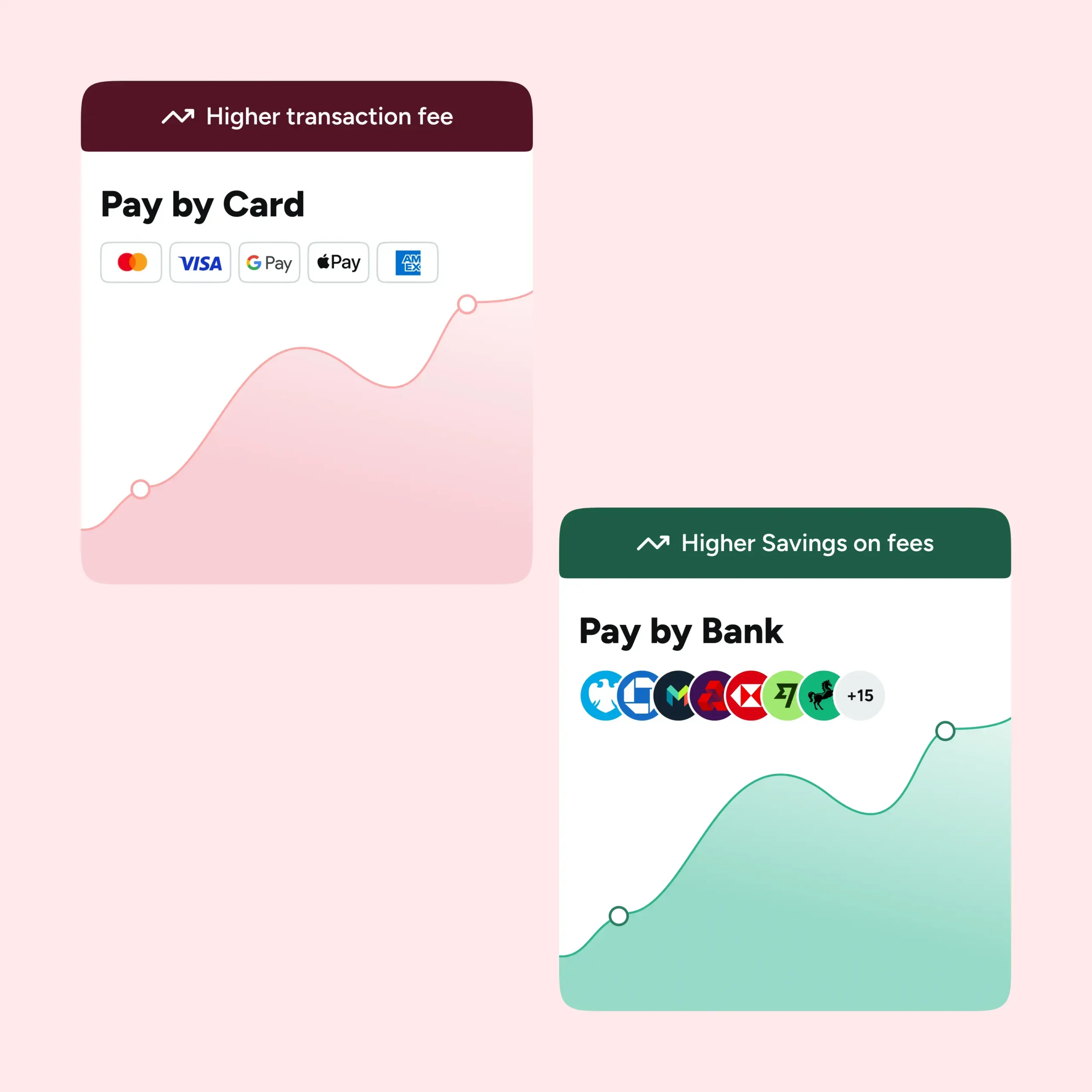
Every card payment travels through a chain of intermediaries: the card network, the issuing bank, the payment processor. Each one takes a cut. Pay by Bank skips that chain entirely. The money moves directly from the customer’s bank account to yours via the UK’s Faster Payments network. No Visa, no Mastercard, no interchange fees sitting in the middle.
That structural difference is why Pay by Bank rates are lower. It is not a promotional rate that gets revised upward later. There is genuinely less infrastructure involved.
Card payments already account for 61% of all UK payments, and according to UK Finance, that share is forecast to grow to 66% by 2033. More card payments means more fees flowing to card networks. Pay by Bank is how businesses start opting out of that.
Where Atoa comes in
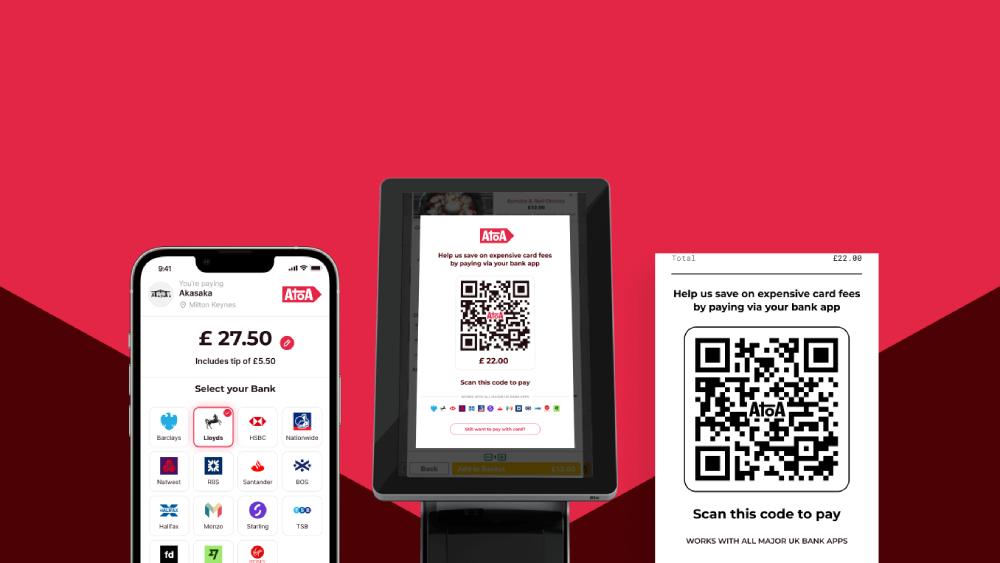
Atoa is a UK-based, FCA-authorised payment provider that offers Pay by Bank and card payments from a single platform. Pay by Bank pricing starts at 0.6% per transaction plus a small authorisation fee, which works out significantly cheaper than Stripe’s standard UK card rate at volume. Payments settle instantly, there are no contracts, and setup does not require a developer.
For businesses that still want to give customers the option to pay by card, Atoa supports that too. Customers can choose when sent a payment link. It also integrates with Xero, QuickBooks, and Sage, so your accounts stay reconciled without any extra legwork.
The honest comparison: if your business is UK-focused, takes mostly domestic payments, and does not need Stripe’s global infrastructure or advanced billing logic, you are likely paying more per transaction than you need to.
So which one should you go with?
Stripe is still the right call for businesses with international customers, complex subscription setups, or developer-built integrations that depend on its API. Square and SumUp make sense for straightforward in-person card payments. PayPal Zettle works well if you are already deep in the PayPal ecosystem.
But for UK-focused businesses where fees, cash flow, and instant settlement actually move the needle, Atoa is a strong Stripe alternative UK businesses are increasingly choosing — not because Stripe is bad, but because cheaper and faster is a hard combination to argue with.
Want to know what Atoa’s fees would look like against your current payment volumes? Get in touch with the team for a breakdown tailored to your business.
SHARE ARTICLE
Share link copied!