
Ready to get started?
Easily integrate next-generation payments and financial data into any app. Build powerful products your customers love.
SHARE ARTICLE


 Share link copied!
Orthodontic treatment is rarely a one-off appointment. It is a long-term commitment that can span months or even years, involving braces, aligners, retainers, and regular check-ups. Because of this, orthodontic treatment payments tend to be larger, split across time, and more sensitive than routine dental treatments like cleanings or fillings.
Orthodontics is a specialist branch of dentistry, It focuses on correcting tooth and jaw alignment. Treatments are typically higher in value and often paid through deposits and instalments. As demand for corrective and cosmetic orthodontics continues to rise, especially among adults, how patients pay becomes just as important as the treatment itself.
Why traditional payment methods slow things down
Many orthodontic clinics still rely on card payments, manual bank transfers, or offline payment plans. These methods work, but they often create unnecessary complexity.
Card fees increase in line with treatment value, which quickly impacts margins on high-ticket care. Manual bank transfers require patients to switch apps, copy references, and confirm details themselves. While patients usually complete the payment, this extra effort often leads to delays, follow-up calls, and uncertainty around whether a payment has actually been made.
Instalment plans add another layer of work. Clinics must track who has paid, who has not, and when the next payment is due. For practices managing many active treatment plans at once, this admin overhead quietly consumes time that could be spent on patient care.
How Pay by Bank fits orthodontic payments better
Pay by Bank allows patients to make a payment directly from their own banking app through a secure, guided flow. Instead of entering card details or setting up a manual transfer, the patient selects their bank, reviews the payment details, and approves it using the same security they already use for everyday banking, such as a PIN, fingerprint, or Face ID.
Once approved, the money moves straight from the patient’s account to the clinic. There are no card details to manage and no references to chase.
This works particularly well for orthodontic practices when collecting:
- Treatment deposits at consultation
- Instalment payments across the treatment period
- Remote payments for retainers, adjustments, or follow-ups
Because payments are authorised within the bank app, they are reliable and settle faster. Fees are also more predictable and typically lower than card percentages, which matters when treatment values are high.
Improving the patient experience at the same time
Orthodontic care relies heavily on trust. Patients are committing to long-term treatment and significant costs. Repeatedly asking them to enter card details or remember bank references adds mental load and increases the chance of delays or missed payments.
Pay by Bank removes that mental effort. Patients pay using a process they already recognise and trust. Payment confirmation is clear and immediate, which is reassuring when paying larger amounts. Clinics can share secure payment links by SMS or email, allowing patients to pay from home rather than making an extra trip to the practice. This benefits both the clinic and the patient.
Making it work in practice with Payment Pages
To make Pay by Bank work smoothly in day-to-day clinic operations, orthodontic practices often rely on platforms like Atoa that are also built for healthcare-style payment journeys. Rather than changing how clinics run appointments or manage treatment plans, Atoa fits around existing workflows and simplifies how payments are collected over time.
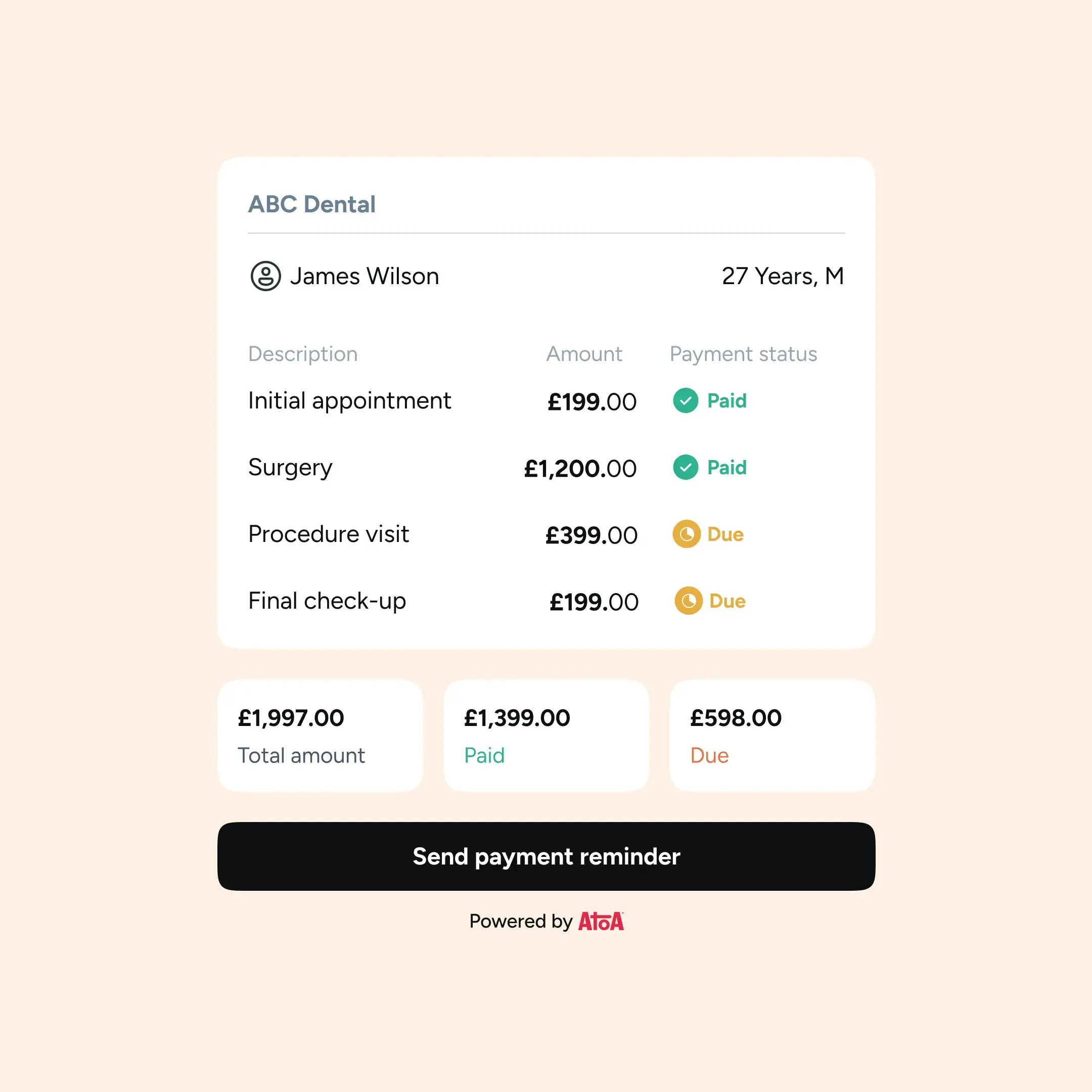
One feature that works particularly well for orthodontics is Payment Pages. This feature allows clinics to collect and manage payments from multiple patients using a single secure link or QR code. Instead of creating and sending separate payment links for every instalment, practices can share one reusable page and track all incoming payments in real time.
This is especially useful for long-term orthodontic treatments where payments are spread across months. Clinics can collect customer details, monitor progress at a glance, and reduce the need for manual tracking. Payment Pages also support partial payments, giving patients flexibility while making it easier for clinics to see exactly what has been paid and what is outstanding.
The result is fewer payment-related follow-ups, clearer visibility into cash flow, and more time for teams to focus on patient care rather than administration.
Final thoughts
Orthodontic treatments are different from routine dental care. They are higher in value, longer in duration, and built on ongoing patient relationships. Payment systems need to reflect that reality.
Clinics that adopt Pay by Bank typically see faster payments, lower fees on large transactions, fewer payment-related conversations, and clearer visibility into what is coming in. With tools like Payment Pages and partial payments, practices can reduce admin, improve the patient experience, and spend more time focused on delivering quality care rather than managing money.
Book a demo with the Atoa team to experience this first hand and simplify the process of collecting payments.
FAQs
Can Pay by Bank be used for instalment payments?
Yes. Clinics can share payment links for each instalment or use Payment Pages through the Atoa platform to collect payments over time, including partial payments where appropriate.
Is Pay by Bank secure for high-value treatments?
Yes. Payments are authorised inside the patient’s own banking app using the same security already in place for their everyday banking. UK banking apps use Strong Customer Authentication, including PINs and biometric checks, making this a highly trusted way to move larger sums.
How does this reduce admin for clinics?
Payments are confirmed instantly, tracked automatically, and easier to reconcile. Clinics spend less time checking statements, sending reminders, or answering payment queries, which significantly reduces back-office workload.
Can Payment Pages help with long-term treatment plans?
Yes. Payment Pages are particularly useful for orthodontics. They allow clinics to manage multiple payments from multiple patients using one central page with full visibility.
SHARE ARTICLE
Share link copied!