
Ready to get started?
Easily integrate next-generation payments and financial data into any app. Build powerful products your customers love.
SHARE ARTICLE


 Share link copied!
Ask any practice manager what eats into their day, and payment collection will not be far down the list. A client agrees to a retainer, the matter gets underway, and before long the balance needs topping up. Cue the email chase. The missed call. The follow-up. The awkward conversation about an outstanding amount when you would rather be talking about the case.
It does not have to work this way.
Having a card on file means the payment side of retainer billing largely takes care of itself. The client consents once, the details are stored securely, and future charges go through without anyone having to chase or be chased. For busy law firms managing multiple ongoing matters, that shift in dynamic is more valuable than it might first appear.
What does “card on file” mean?
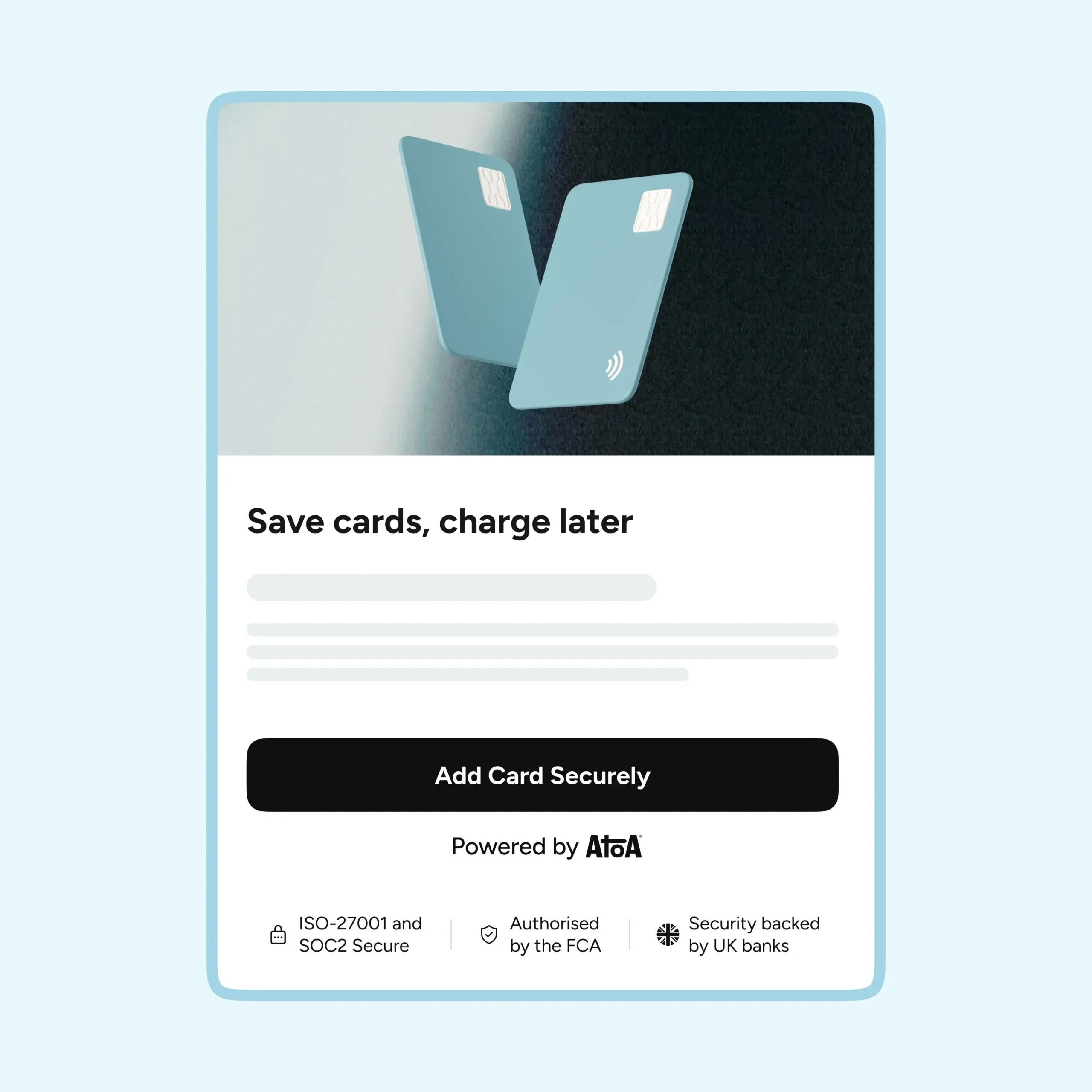
Card on file is exactly what it sounds like: a client’s card details are stored securely, with their explicit consent, so future payments can be collected without them needing to take any action each time.
For law firms managing retainer-based billing, this is particularly useful. Rather than contacting a client every time their account needs topping up, you already have the authorisation in place. The payment goes through, the account is replenished, and everyone can get on with the actual work.
Card on file is not the same as setting up a direct debit. It is more flexible, faster to set up, and does not require a lengthy mandate process. Clients verify once, and you are set.
Why retainer billing makes this especially relevant
In retainer-based arrangements, particularly in ongoing matters, the retainer typically remains on account until the conclusion of the case. As matters progress, replenishments are often required to ensure sufficient funds remain available to cover continued representation.
That replenishment cycle is where card on file earns its place. Instead of breaking the flow of a case to chase a payment, you can collect what is owed and keep things moving.
For law firms, retainers support steady cash flow. It also helps ensure that client commitment is backed by actual funds, reducing the risk of unpaid invoices and supporting smoother allocation of fee earners’ time. A card on file arrangement reinforces exactly that.
How Atoa’s card on file feature works
Atoa’s card on file feature works great for law firms. Once a client saves their card, you can charge them for future payments without them having to do anything each time. There is no manual re-entry of details and no awkward phone calls to collect a top-up.
Here is what the process looks like in practice:
- Store once. The client saves their card securely through Atoa. The whole thing is verified with an OTP, so they are actively consenting to the arrangement.
- Charge as needed. Once the card is on file, you can collect future payments instantly, whether that is a retainer top-up, a consultation fee, or an invoice settlement.
- Track everything. Payments are confirmed in real time, so your records are always up to date without any manual reconciliation.
For legal retainer payment processing, this removes a lot of the back-and-forth that traditionally slows things down.
Collecting one-off fees is just as straightforward
Beyond recurring retainer billing, Atoa’s payment link feature handles the kinds of one-off charges that come up regularly in legal practice. Law firms are using payment links to collect consultation fees, initial retainers, and invoice settlements. Payments are trackable, secure, and confirmed in real time, which means less time spent following up and more time spent on client matters. Law firms already using Atoa have seen the difference first-hand.
Watch this short video to hear directly from one of them.
The two features work well alongside each other. Payment links handle immediate, one-off collections. Card on file takes care of the recurring side. Together, they cover most of what a busy firm needs.
The practical upside for your firm
The honest reason most law firms are interested in tools like this is straightforward: getting paid on time, without it becoming a part-time job.
Clients today want convenience, security, and flexibility when settling their legal costs. According to BigHand’s 2024 Annual Law Firm Finance Report, six in ten law firms saw write-offs increase over the past year, prompting nearly two-thirds to plan more frequent billing and collection. Reducing friction at the payment stage is one of the most straightforward ways to address that.
Card on file fits neatly into that expectation. Clients appreciate not being chased for payments. Fee earners appreciate not having to do the chasing. And practice managers appreciate knowing that cash flow is not dependent on a client remembering to make a bank transfer.
For legal retainer payment processing specifically, the combination of stored card details, OTP verification, and real-time confirmation gives you a setup that is both client-friendly and operationally sound.
Built with security at its core
Atoa is FCA-authorised, and the card on file feature is designed with security built in from the start. Every card is stored securely. An OTP verification ensures that the client actively consents before any charge is made. No payment is taken without upfront authorisation. So this means, clients are always in control. For law firms working within SRA guidelines on client money and billing transparency, that clear audit trail is a genuine advantage.
Ready to simplify your retainer billing?
If your firm is spending more time than it should on payment collection, card on file is worth a closer look. The setup is straightforward, the client experience is smooth, and the operational benefits show up quickly. Whether you are managing a handful of long-running retainers or billing across a high volume of matters, removing friction from the payment process frees up time that is better spent elsewhere. Less admin, fewer reminders, and no more awkward conversations about overdue top-ups.
Book a demo with Atoa to see how it works in practice and whether it fits your existing billing setup.
SHARE ARTICLE
Share link copied!