
Ready to get started?
Easily integrate next-generation payments and financial data into any app. Build powerful products your customers love.
SHARE ARTICLE


 Share link copied!
If you run a Shopify store in the UK, payment fees are probably one of those costs you accept without thinking too hard about. But when you actually break it down, the numbers tell a more interesting story.
Shopify charges card processing fees through Shopify Payments ranging from 2% + 25p per transaction on the Basic plan down to 1.5% + 25p on the Advanced plan. If you use a third-party payment provider instead of Shopify Payments, Shopify layers an additional transaction fee on top of whatever the provider charges. It’s 2% on Basic, 1% on the Grow plan, and 0.6% on Advanced. That is two sets of fees on the same transaction.
For a store turning over £30,000 a month on the Basic plan, those fees add up to a meaningful sum every year. And for most store owners, the assumption has always been that card payments are simply the only way to do it. That is changing.
What Pay by Bank actually is
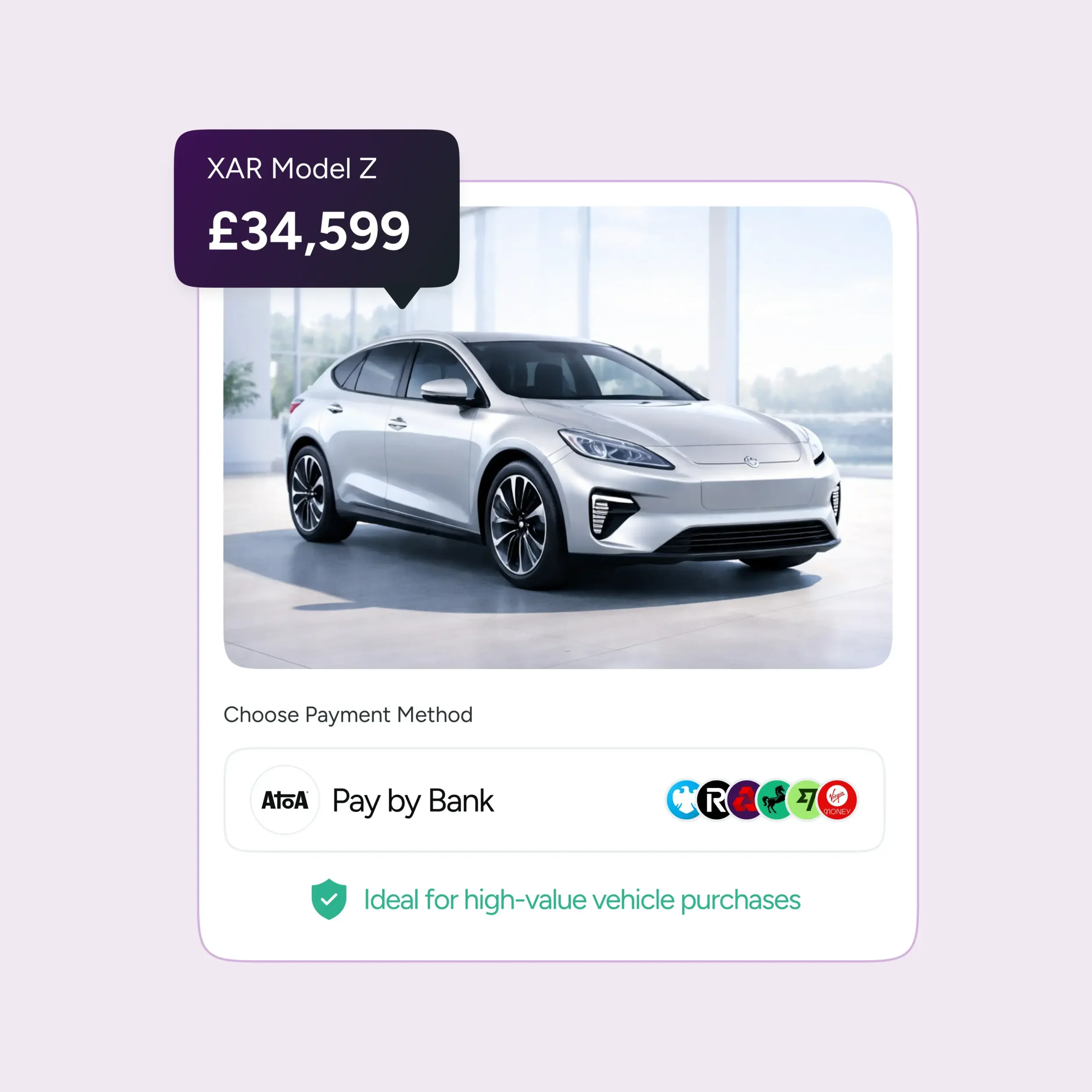
Pay by Bank is a checkout payment method powered by open banking. Instead of entering card details, a customer selects Pay by Bank, chooses their bank, and approves the payment inside their Bank app biometrically using Face ID or fingerprint, or with a passcode. The money then moves directly from their account to yours via the UK’s Faster Payments network. No card network in the middle, no interchange fees, and no waiting days for the money to arrive.
It is not a new concept, but it has crossed into mainstream territory fast. Amazon and eBay both added Pay by Bank as a checkout option in the UK in 2026. This tells you something about where customer comfort levels are heading. According to the FCA’s latest open banking progress update, there are now more than 16 million open banking users in the UK, with open banking payments growing 53% year on year in 2025. The audience for Pay by Bank is not just there, it is growing fast.
How to add Pay by Bank to your Shopify checkout
Atoa has two plugins available on the Shopify App Store: one for Pay by Bank and one for card payments. Both install quickly with no developer resource needed.
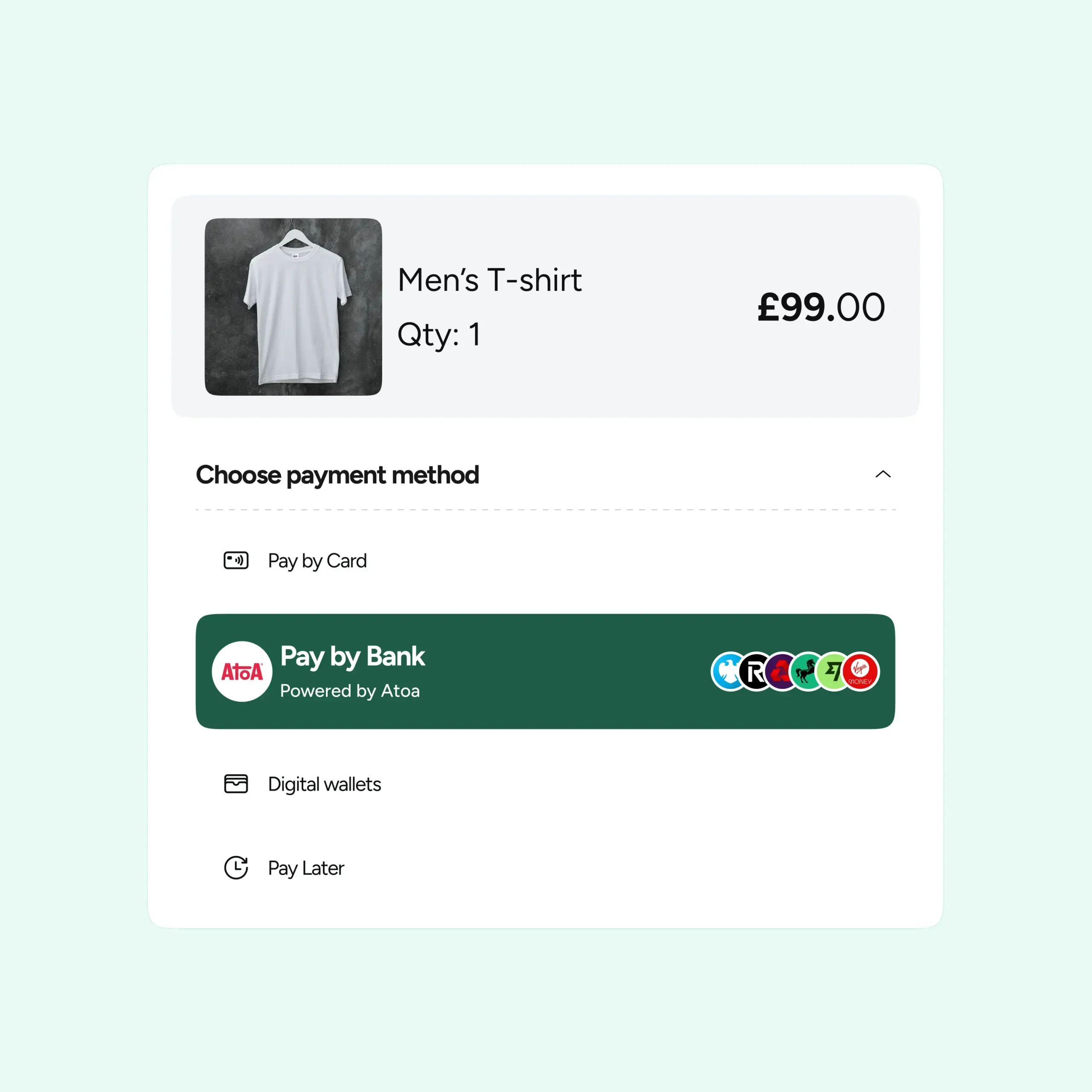
With the Atoa Pay by Bank plugin, customers see “Atoa — Pay by Bank” as a payment option at checkout. They select it, get redirected to their UK Bank app, approve the payment securely, and land back on your confirmation page. The whole thing takes seconds. For the store owner, it means lower fees, instant settlement, one-click refunds, and no hidden costs or contracts.
The card payments plugin works the same way for customers who prefer to pay by card. Both plugins sit in the checkout together, so you are not choosing one over the other. You are offering both.
Card payments still have their place
None of this means card payments are going away. Some customers will always prefer to pay by card. And the last thing you want is to lose a sale because your checkout does not offer what someone is looking for. The point is not to replace cards but to give customers more choice while steering the economics in your favour.
The practical approach is to offer both. Make Pay by Bank visible and easy to find at checkout. Let the lower fees and instant settlement do their work over time, and keep card payments available for anyone who wants them. As more customers become familiar with approving payments through their banking app, the proportion of lower-cost Pay by Bank transactions will naturally grow.
Flexible checkout, better margins, faster payouts. That is what adding Pay by Bank to your Shopify store gets you. It is one of the more straightforward ways to reduce Shopify transaction fees without changing anything else about how your store runs.
In conclusion
Getting paid should not be expensive. With both Pay by Bank and card payments available at checkout, you are not asking customers to change how they pay. You are just making sure that when they choose the bank option, you are both better off for it.
Book a demo with the Atoa team and get a better understanding of how you can reduce Shopify transaction fees and boost the checkout experience for customers.
Frequently asked Questions
What are Shopify transaction fees?
Shopify transaction fees are the charges applied to each sale in your store, made up of card processing fees plus, if you use a third-party payment provider, an extra Shopify transaction fee on top. Shopify Payments card rates run from 2% + 25p on the Basic plan down to 1.5% + 25p on Advanced. Using an outside provider adds a further fee of 2% on Basic, 1% on Grow or 0.6% on Advanced.
How can I reduce Shopify transaction fees?
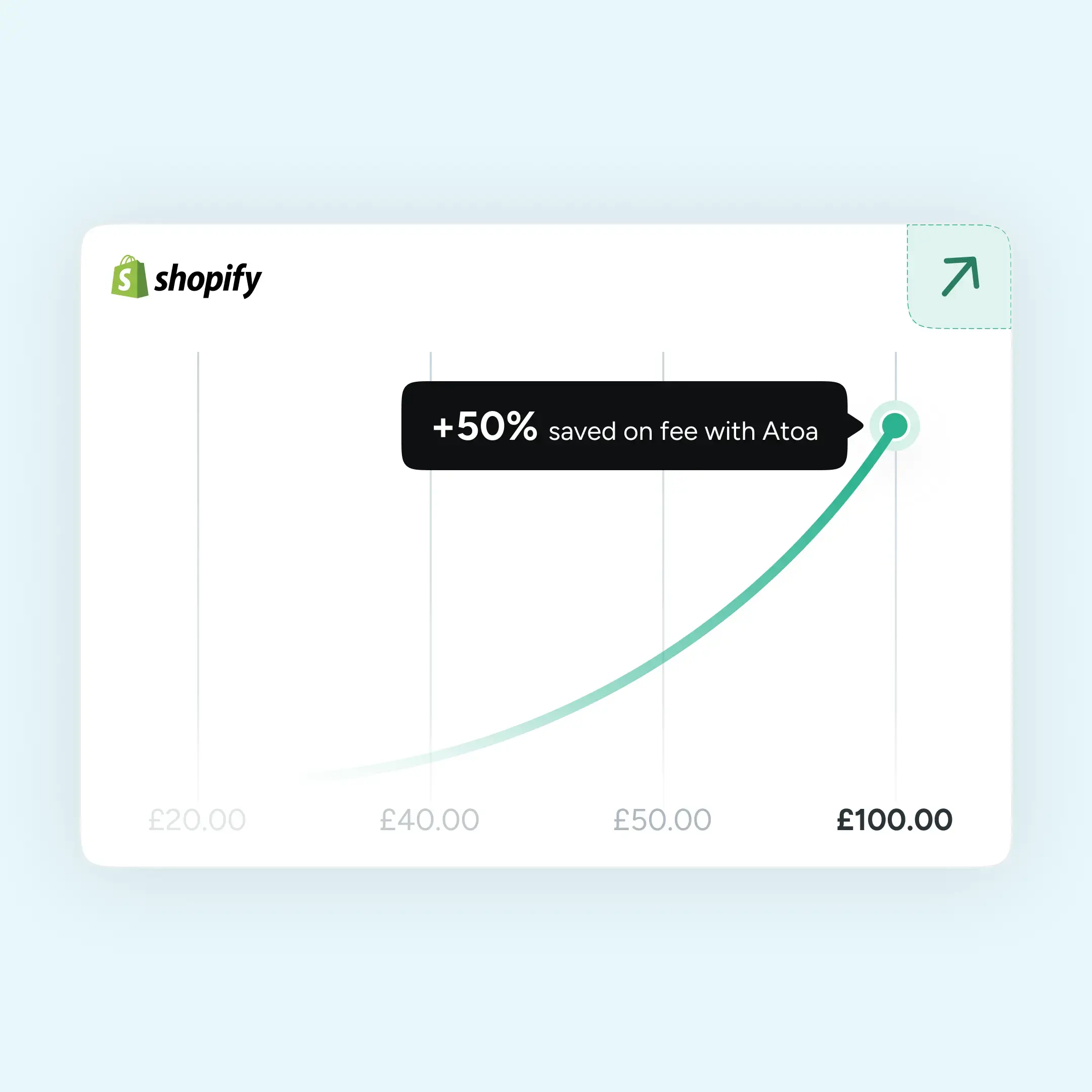
You can reduce Shopify transaction fees by adding Pay by Bank alongside cards at checkout, so lower-cost open banking payments take a growing share of sales. Pay by Bank moves money bank to bank over Faster Payments with no card network in the middle, which can cut costs by up to 50% compared with card fees. Atoa offers a Shopify plugin for Pay by Bank and one for cards, both installable without a developer.
Do I have to use Shopify Payments?
No, you do not have to use Shopify Payments. You can use a third-party provider instead, though Shopify then adds its own transaction fee on top of that provider’s charges. Adding Pay by Bank through Atoa gives customers a lower-cost way to pay while you keep cards available for anyone who prefers them.
How does Pay by Bank lower checkout costs?
Pay by Bank lowers checkout costs by moving money directly from the customer’s bank account to yours over the UK’s Faster Payments network, avoiding card networks and interchange fees. With Atoa, Pay by Bank starts from 0.7% + VAT, up to 50% lower than typical card fees. Settlement is usually 3 to 6 seconds, so funds arrive quickly.
Can I offer both cards and Pay by Bank on Shopify?
Yes, you can offer both cards and Pay by Bank on Shopify at the same time. Atoa has two Shopify App Store plugins, one for Pay by Bank and one for card payments, and both sit in the checkout together. This gives customers choice while steering more transactions towards the lower-cost bank option over time.
SHARE ARTICLE
Share link copied!